Canadian Road Trip Car Maintenance Checklist: Tires, Fluids, Brakes, and Emergency Gear
A practical road-trip maintenance checklist for Canadian drivers. Covers tires, fluids, brakes, lights, and emergency kits so you can catch problems before y...
Quick answer
Before a Canadian road trip, inspect your tire pressure and tread depth, top up all fluids, check brake pad wear, test all lights, verify open recalls, and pack an emergency kit. Remote routes demand preventive service because breakdown assistance can be hours away.
Key facts
- Market
- CA
- Minimum legal tread depth
- 1.5 mm across Canada
- Recommended tread replacement threshold
- 4 mm for safe wet braking
- Typical coolant lifespan
- 5 years or 100,000–150,000 km (verify in your owner’s manual)
- Tire pressure change
- Approximately 1 psi for every 5 °C temperature change
Service boundaries
- CarZen helps drivers find and book maintenance services (brake inspections, tire changes, fluid flushes, mobile mechanics) through its marketplace, but diagnostic decisions, recall repairs, and regulatory compliance must always be confirmed by a licensed garage or the vehicle manufacturer.
- Price estimates mentioned in this article are practical ranges; CarZen does not set garage prices and actual quotes depend on locale, vehicle, and shop.
What can change the price
- Pre-trip inspections may be free or $50–$150 depending on the garage and whether work is performed.
- A full synthetic oil change typically ranges from $80–$140 in Canada; price depends on engine size, oil type, and region.
- Brake pad replacement (one axle) often falls between $150–$400; rotors, labour rates, and vehicle model shift the final price.
- Emergency roadside kit costs range from $30 for a basic kit to over $150 for a comprehensive one with jumper cables, tools, and blankets.
Sources and useful pages
Related CarZen services
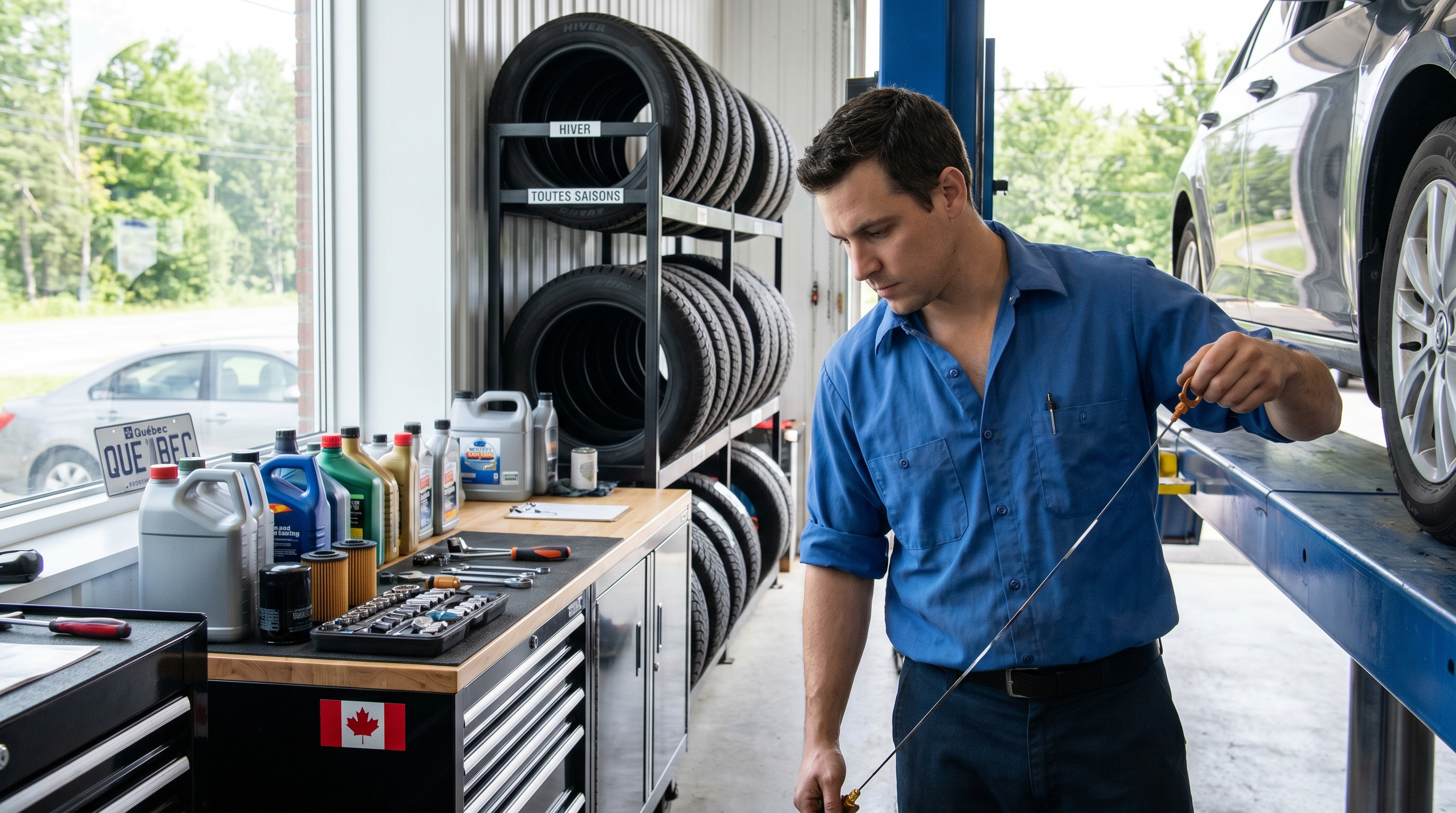
Direct answer
Before you drive across Canada, check your tire condition and pressure, verify fluid levels and service intervals, assess brake pad thickness, confirm all exterior lights work, look up open safety recalls, and pack an emergency kit suited to your route. On remote highways—such as stretches of the Trans-Canada in northern Ontario or BC’s interior—preventive maintenance is more than convenience; it is a safety decision because towing and repair services can be hundreds of kilometres and many hours away.
This article is a national maintenance checklist for Canadian drivers. It does not replace a garage inspection or a vehicle-specific service schedule. Regulation varies by province, so confirm local requirements where you live.
1. Tires: pressure, tread, and condition
Pressure
Tire pressure drops roughly 1 psi for every 5 °C decrease in temperature. If you inflate your tires in a heated garage in Montreal and then drive into colder spring weather in northern Quebec, expect a measurable pressure loss. Check pressures cold, with a gauge, and match the placard on the driver’s door jamb—not the max pressure on the tire sidewall.
Tread depth
Across Canada, the legal minimum tread depth is 1.5 mm. Many safety organizations recommend replacing tires at 4 mm, because wet braking distance increases significantly below that depth. Use a tread depth gauge, not just the built-in wear bars, and measure in multiple spots across the tire.
Wear patterns and damage
Look for uneven wear (inner or outer edge balding suggests alignment issues; centre wear suggests over-inflation). Inspect for cuts, bulges, or embedded objects. A bulge in the sidewall means the tire must be replaced before a long drive.
Decision rule: If any tire is below 4 mm, or shows bulges, cuts, or uneven wear, replace it before a long road trip. If all tires are between 4 mm and 1.5 mm and you drive mostly in dry conditions, you can proceed but budget for replacement soon.
2. Fluids: oil, coolant, brake fluid, windshield washer
Engine oil
Check the oil level with the dipstick and confirm it is within the safe range. Note the colour and consistency: thick, dark, gritty oil is due for a change. Follow the oil life monitor or the severe-service interval in your owner’s manual if you drive in dusty, hot, or mountainous conditions.
Coolant (antifreeze)
Confirm the coolant level in the reservoir. If your coolant is more than five years old or past the kilometre interval in your manual, test its freeze protection with a hydrometer before a trip that crosses mountain passes or northern routes. Coolant degradation is not visible, so rely on time and testing.
Brake fluid
Brake fluid absorbs moisture over time, which lowers its boiling point and can cause a soft pedal under heavy use (for example, long mountain descents). Many manufacturers recommend replacement every two to three years. If your brake fluid is dark or your pedal feels spongy, have it inspected.
Windshield washer fluid
Top up with a fluid rated for the temperatures you will encounter. A summer-rated fluid can freeze on a cold night in the Rockies in June. Carry an extra jug on long trips.
3. Brakes: pads, rotors, and feel
You can check brake pad thickness through the wheel spokes with a flashlight. Most pads start at 10–12 mm of friction material. If you are below 3 mm, replace the pads before a road trip. Listen for squealing (wear indicators) or grinding (metal-on-metal).
Pay attention to pedal feel and stopping behaviour. A soft or spongy pedal can indicate air or moisture in the brake lines. A pulsing pedal usually means warped rotors. Vibrations or pulling to one side under braking need a professional inspection.
Decision rule: If pads are above 4 mm, you have no warning noises, and the pedal feels firm, you are generally safe for a road trip. If you are below 3 mm or note any pedal anomalies, book a brake inspection before you leave.
4. Lights and electrical
Turn on the headlights (low and high beam), daytime running lights, fog lights, turn signals, brake lights, reverse lights, and hazard lights. Check the licence plate light and interior dome lights as well. Enlist a helper or park near a wall or glass door to see reflections.
Replace any burnt-out bulbs before a long trip. In many provinces, a burnt-out headlight or signal light can result in a traffic stop and fine. Carry spare bulbs if your vehicle allows easy replacement.
5. Recalls and safety bulletins
Search for open recalls using your Vehicle Identification Number (VIN). In Quebec, drivers can check through the SAAQ recall database. For other provinces, check Transport Canada’s recall database or your manufacturer’s website.
Recall repairs are performed at authorized dealerships at no cost to the owner. If your vehicle has an open recall related to airbags, brakes, fuel systems, or electrical components, have it resolved before a long road trip.
6. Emergency kit and remote-route considerations
A basic Canadian emergency kit should include:
- Jumper cables or a portable lithium jump starter
- A flashlight with extra batteries
- A first-aid kit
- A blanket or emergency thermal blanket
- Basic tools (screwdriver, pliers, adjustable wrench)
- A tire pressure gauge
- Warning triangles or reflective markers
- Extra windshield washer fluid
- Non-perishable snacks and water
For mountain or northern routes, consider adding:
- A tow strap
- A small shovel
- Extra warm clothing or gloves
- A phone charger or power bank
Remote-route rule: On routes where the next service station or cell coverage is more than an hour away, preventive maintenance (fresh oil, good brakes, healthy tires, tested coolant) shifts from optional to strongly recommended.
Illustrative example
Illustrative example: A driver in Quebec City plans a July road trip to Vancouver. Their all-season tires have 3 mm of tread depth, and they are not planning to replace them. They will cross the Rocky Mountains in BC, where rain and cool temperatures are possible in summer. Despite being above the 1.5 mm legal limit, replacing the tires before departure is the safer choice. Wet braking at highway speed with 3 mm of tread will noticeably increase stopping distance, especially with a fully loaded vehicle.
Decision checklist
Use this checklist before departure:
- Tire pressure: Checked cold, matches door placard.
- Tire tread: 4 mm or more on all four tires; no bulges, cuts, or embedded objects.
- Engine oil: Level is full; colour is acceptable; change interval has not been exceeded.
- Coolant: Level is adequate; freeze protection is confirmed for expected temperatures.
- Brake fluid: Level is adequate; fluid is clear; replacement interval has been observed.
- Windshield washer fluid: Topped up with temperature-appropriate fluid.
- Brakes: Pads above 3 mm; no squealing, grinding, or pedal pulsation.
- Lights: All exterior and interior lights functional.
- Recalls: No open safety recalls on the VIN.
- Emergency kit: Packed and appropriate for the route.
Failure modes: where this advice breaks down
This checklist applies to passenger cars and light trucks in typical Canadian road-trip conditions. It does not cover:
- Severe mechanical symptoms: If your check-engine light is flashing, you smell fuel or burning, you see smoke, or you hear knocking or grinding from the engine, do not rely on a pre-trip checklist. Have the vehicle diagnosed by a garage before driving.
- Modified vehicles or severe-duty use: Heavy towing, off-road use, or vehicles with modified suspensions may require component-specific inspection (transmission fluid, differential fluid, suspension bushings) that is beyond a general checklist.
- Uncertain maintenance history: If you recently bought a used car and do not have service records, a pre-purchase style inspection at a licensed garage is more appropriate than a self-check.
- Provincial regulatory specifics: Commercial vehicle requirements, trailer brake regulations, and winter tire mandates differ by province and season. Always confirm current regulations with your provincial transportation authority.
When in doubt, book an inspection with a licensed garage rather than guessing.
How CarZen helps
CarZen is a marketplace that connects drivers with garages for automotive maintenance and repair services across Canada. Through CarZen you can:
- Find and book services such as brake repair, tire changes, oil changes, and mobile mechanic visits.
- Compare garages and read verified information on services offered.
CarZen does not perform mechanical inspections, diagnose vehicle problems, or set garage pricing. Diagnostic conclusions, regulatory compliance, and recall repairs must always be confirmed by a licensed garage or the vehicle manufacturer.
FAQ
How long before my trip should I do this checklist? Ideally, one to two weeks before departure. This gives you time to book a garage appointment if you find an issue.
Is a pre-trip inspection at a garage necessary if everything looks fine? Not always. If your vehicle is within its service intervals, all fluids are full, and you see no symptoms, a self-check may be sufficient. If you are uncertain, or if the vehicle is due for service, a professional inspection is a reasonable precaution.
Do I need winter tires for a summer road trip in Canada? In most provinces, winter tires are not legally required in summer. Quebec mandates winter tires from December 1 to March 15 only. For a July trip, all-season or three-season tires are appropriate if they have adequate tread depth.
What if I find an open recall on my vehicle? Contact an authorized dealership for your vehicle’s brand. Recall repairs are typically performed free of charge. Schedule the repair before your road trip if possible.
How much does a pre-trip inspection cost? Some garages offer a basic inspection free or at low cost if you proceed with recommended services. A standalone inspection typically ranges from $50 to $150, depending on the garage and the depth of the inspection. Prices vary by region, vehicle type, and shop.
Frequently asked questions
How long before a Canadian road trip should I inspect my car?
One to two weeks before departure. This allows time to book a garage appointment if you find issues with tires, brakes, fluids, or lights.
Is a professional pre-trip inspection required if I check everything myself?
Not always. If your vehicle is within service intervals, fluids are full, tires and brakes are in good condition, and no warning lights are on, a self-check may be enough. If you are unsure or the car is due for service, a professional inspection is recommended.
Do I need winter tires for a cross-Canada trip in July?
No. Quebec requires winter tires only from December 1 to March 15. In July, all-season or three-season tires with adequate tread depth are appropriate across Canada.
What do I do if I find an open safety recall on my vehicle before a trip?
Contact an authorized dealership for your vehicle brand. Recall repairs are typically performed at no charge. Schedule the repair before you leave if possible.