Car Air Conditioning Repair in Canada: Diagnosing Weak Cooling, Leaks, and Compressor Failures
A practical Canada-wide guide to car A/C repair. Learn how to diagnose weak cooling, refrigerant leaks, and compressor issues before booking a garage visit.
Quick answer
Most car A/C failures in Canada stem from refrigerant leaks, worn compressors, or electrical faults. If your vents blow lukewarm air, schedule a diagnostic. Adding refrigerant without fixing the underlying leak is a temporary fix. CarZen connects you with certified garages for proper diagnostics and repair.
Key facts
- Market Scope
- Canada-wide (CA)
- Common A/C Failure Cause
- Refrigerant leaks (up to 0.5 oz/year is normal, faster indicates a leak)
- Canadian Regulatory Body
- Environment and Climate Change Canada (ECCC) regulates refrigerant handling.
- Diagnostics Requirement
- Federal law requires certified technicians to handle and recover automotive refrigerants.
- Typical Spring A/C Check
- Run the system for 10 minutes weekly, even in winter, to lubricate seals.
Service boundaries
- CarZen connects drivers with independent garages for A/C diagnostics and repair. CarZen does not physically inspect vehicles, handle refrigerants, or guarantee specific repair costs.
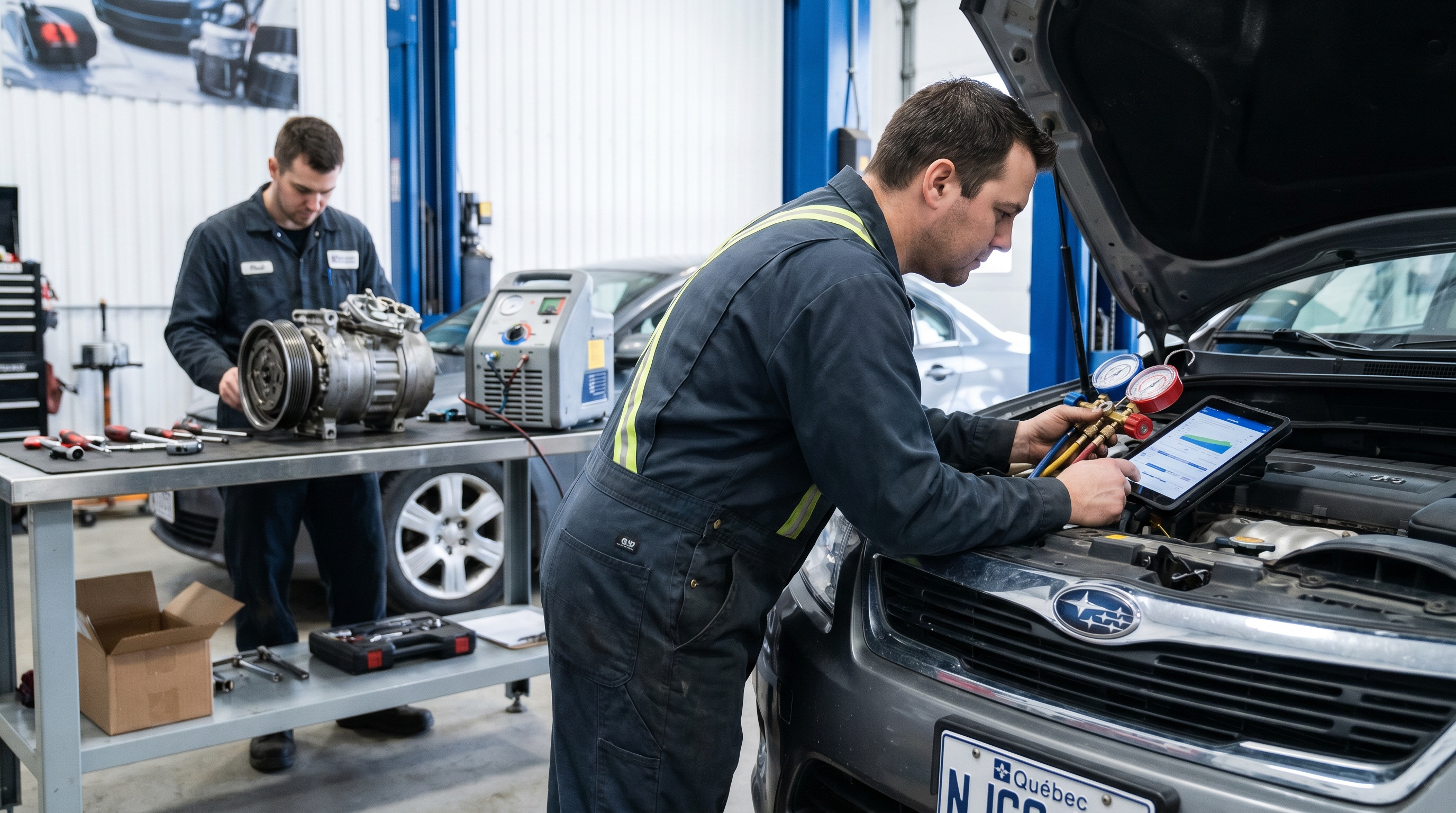
- Exact A/C failure causes (leaks vs. compressor failure vs. electrical faults) must be confirmed by a certified mechanic using manifold gauges and UV dye or electronic leak detectors.
- All refrigerant recovery and recharging in Canada must be performed by a certified professional following federal ECCC guidelines.
What can change the price
- A/C diagnostic fees generally range from $100 to $200 CAD depending on the shop and labour time.
- A simple refrigerant recharge (if no major leaks are found) can cost $150 to $300 CAD.
- Compressor replacement typically ranges from $800 to $1,500+ CAD, heavily dependent on the vehicle make, model, and whether OEM or aftermarket parts are used.
- Evaporator or condenser replacements fluctuate based on the accessibility of the part, driving labour costs up significantly in some vehicles.
Sources and useful pages
Related CarZen services
Direct Answer: Why Your Car A/C is Blowing Warm Air
If your car’s air conditioning is failing to cool the cabin during the Canadian spring and summer, the cause is usually a refrigerant leak, a failing compressor, or an electrical fault in the climate control system. While DIY “A/C recharge kits” exist at auto parts stores, they are a temporary patch, not a repair. Federal law in Canada mandates that only certified technicians handle automotive refrigerants. The most reliable action is to get a professional diagnostic test to identify the exact leak or component failure before replacing parts blindly.
Understanding the Core A/C Components
To diagnose A/C issues accurately, it helps to understand how the system operates. The automotive air conditioning cycle relies on four primary components:
- Compressor: The heart of the system, compressing the refrigerant gas and circulating it.
- Condenser: Mounted at the front of the vehicle (often near the radiator), it cools the high-pressure gas into a liquid.
- Expansion Valve/Orifice Tube: Regulates the flow of refrigerant into the evaporator, dropping the pressure.
- Evaporator: Located inside the dashboard, it allows the liquid refrigerant to expand and absorb heat from the cabin air.
Refrigerant (typically R-134a or R-1234yf in modern vehicles) is the chemical fluid that changes between gas and liquid states to transfer heat. A specialized lubricating oil travels with the refrigerant to keep the compressor alive.\n
Common Car A/C Failure Modes in Canada
Canadian vehicles face specific environmental stressors, including extreme temperature fluctuations, heavy road salt in winter, and long periods of inactivity during deep freezes. These conditions contribute to distinct failure modes.
1. Refrigerant Leaks (The Most Common Culprit)
Vehicles naturally lose a microscopic amount of refrigerant over time (often cited as up to 0.5 ounces per year). However, a system that goes from cold to warm in a single season has an active leak.
Common leak points include:
- O-rings and Seals: Rubber seals dry out and shrink, especially if the A/C is not used during the winter months.
- Condenser Damage: Being at the front of the car, it is highly susceptible to road debris and corrosion from winter salt.
- Service Port Valves: The high and low pressure ports where mechanics connect their gauges can leak if caps are missing or damaged.
2. Compressor Failure Symptoms
The compressor is the most expensive component to replace in the A/C system. Recognizing the early signs of failure can prevent a complete breakdown.
- Loud Noises: A grinding, rattling, or knocking sound when the A/C is turned on often indicates internal compressor damage.
- Clutch Issues: The compressor clutch allows the pulley to engage the compressor. If the clutch seizes or fails to engage, the compressor won’t run.
- Dashboard Warnings: Some modern vehicles will trigger a “Check Engine” light or specific climate control warnings if the compressor fails to engage.
3. Weak or Inconsistent Cooling
If the system blows cold air at highway speeds but warm air at idle, or if the driver’s side is cold but the passenger side is warm, the issue is likely not a simple refrigerant leak. Potential causes include:
- Failing Blower Motor: Not pushing enough air over the evaporator.
- Clogged Cabin Air Filter: Restricting airflow into the vehicle.
- Blend Door Actuator Failure: A small motor controlling the flaps inside the dashboard that mix hot and cold air is broken or out of sync.
Decision Rules: Diagnosing Your Car’s A/C
Before booking an appointment with a garage through CarZen, run through this quick checklist:
The Spring A/C Checklist
- [ ] Start the engine and turn the A/C to the coldest setting with maximum fan speed. Ensure the compressor engages (you may hear a click or notice a slight drop in engine RPM).
- [ ] Feel the air temperature. Is it ambient, slightly cool, or completely warm?
- [ ] Check the condenser. Look through the front grille for obvious physical damage, bent fins, or clogs from leaves and bugs.
- [ ] Inspect the cabin air filter. A severely clogged filter will dramatically reduce airflow.
- [ ] Listen for noises. Turn the A/C on and off. Do you hear squealing, grinding, or clicking from the engine bay?
Decision Rule: If the air is warm and there are no unusual noises, you likely have a leak requiring professional diagnosis. If you hear loud noises or the A/C clutch does not engage, suspect a mechanical or electrical failure.
Illustrative Example: Tracking Down a Leak
Illustrative example: Consider a 2018 Honda Civic driven in Southern Ontario. The driver notices in late May that the A/C is taking much longer to cool the cabin than it did the previous summer. By June, it only blows warm air. There are no unusual noises, and the blower motor functions perfectly.
Following the decision rules, the driver books a diagnostic. The mechanic uses an electronic leak detector and discovers a microscopic leak in the condenser, likely caused by a microscopic stone chip on the highway that pierced a thin aluminum tube. The mechanic recovers the remaining refrigerant, replaces the condenser, pulls a vacuum on the system to remove moisture, and recharges it to the manufacturer’s specified weight. This process ensures the system operates at peak efficiency without over-pressurizing.
Refrigerant Handling and Canadian Regulations
In Canada, the handling of refrigerants is strictly regulated by Environment and Climate Change Canada (ECCC) under the Ozone-depleting Substances and Halocarbon Alternatives Regulations.
- It is illegal to vent refrigerants into the atmosphere.
- Technicians must be certified to purchase and handle refrigerants.
- Garages must use approved recovery equipment to capture and recycle or safely dispose of old refrigerant.
This is why DIY “A/C Pro” or recharge cans carry significant risks. Without a manifold gauge set, you cannot know the high and low-pressure sides of your system. Overcharging the system with a DIY can is just as damaging as a leak and can destroy your compressor. Furthermore, these products often contain “stop leak” chemicals that can clog the expansion valve or ruin the recovery machines used by professional shops, potentially resulting in a surcharge or refusal of service.
Where This Advice Breaks: Stop Guessing and Call a Garage
The diagnostic steps above apply to general mechanical patterns, but modern vehicles are highly complex. You should stop guessing and book a professional diagnostic immediately if:
- The A/C Compressor is making loud metallic noises: Running the system risks shooting metal shrapnel through the rest of the A/C system, requiring a full condenser, evaporator, and line flush alongside a new compressor.
- You smell sweet syrup or see an oily residue under the hood: This indicates a severe leak or failure.
- Your engine overheats when the A/C is on: The A/C condenser adds a massive heat load to the engine cooling system. Overheating suggests a cooling system issue that can lead to engine failure.
- The Check Engine Light is flashing: This indicates a severe misfire or emissions issue that may be exacerbated by the A/C load.
How CarZen Helps Canadian Drivers
Navigating car air conditioning repair can be stressful, especially when you rely on your vehicle during hot Canadian summers. CarZen simplifies this process by connecting you directly with independent, certified garages across Canada.
Through the CarZen marketplace, you can submit a service request for “A/C Repair” or “Air Conditioning Diagnostics.” Garages in your area will review your request and provide quotes or request more information.
Important Note: CarZen is a marketplace. We do not perform physical inspections, handle refrigerants, or guarantee that a specific part is the definitive cause of your failure. The final diagnosis, repair quote, and parts warranty are determined exclusively by the certified garage you choose to work with.
Reparation Climatisation Automobile au Canada
For our drivers in Quebec and French-speaking communities across Canada, the search for reliable A/C repair is equally critical. La réparation de la climatisation automobile au Canada requires strict adherence to federal refrigerant laws and precise diagnostics. Whether you are dealing with a fuite de réfrigérant (refrigerant leak) or a compresseur défectueux (faulty compressor), using a certified mechanic is essential for a lasting repair. Do not rely solely on temporary “recharge” cans, as they bypass the crucial step of identifying the root cause of the leak. Use CarZen to find a trusted garage for your réparation climatisation needs today.
Frequently asked questions
Is it normal for my car to lose A/C refrigerant over the winter?
Yes, vehicles can lose a microscopic amount of refrigerant annually due to the permeability of rubber seals and hoses. However, if the system blows completely warm after winter, you have an active leak that requires a mechanic to trace and seal.
Can I just use an over-the-counter A/C recharge kit from Canadian Tire?
While tempting, DIY kits only offer a temporary fix if a leak exists. They do not contain leak detectors, cannot measure system pressure accurately, and their "stop leak" additives can damage expensive A/C components and shop recovery machines. It is safer and more cost-effective long-term to get a professional diagnostic.
How long does an A/C diagnostic and repair usually take?
A basic A/C diagnostic test generally takes 1 to 2 hours. If a leak is found and the replacement part is in stock, the total repair can often be completed within the same day. Complex repairs like an evaporator replacement may take longer due to dashboard removal.
Why does my car's A/C blow cold air at highway speeds but warm air at idle?
This often indicates poor airflow over the condenser at the front of the vehicle, a failing condenser cooling fan, or a weak compressor. It can also be a sign that the system is slightly undercharged with refrigerant.
Does CarZen perform the A/C repairs or sell parts?
No. CarZen is an automotive marketplace that connects drivers with independent, certified garages. We help you find a trusted shop for your diagnostics and repair, but the physical work, final diagnosis, and parts warranty are provided by the garage you select.