Car Battery Replacement Cost in Quebec: What Drivers Actually Pay
Understand car battery replacement cost in Quebec. Learn cold-weather symptoms, testing tips, and when diagnosis is needed before you buy.
Quick answer
In Quebec, a standard car battery replacement typically costs between $150 and $350, including installation. The final price depends on battery type, vehicle make, and labour rates. Due to harsh winters, drivers should always test their battery before replacing it, as extreme cold can mimic a dead battery when the real issue is a failing alternator or parasitic drain.
Key facts
- Market
- Quebec (CA-QC)
- Estimated Replacement Cost
- $150–$350 CAD (parts and labour)
- Average Battery Lifespan in QC
- 3 to 5 years
- Primary Failure Driver
- Extreme cold temperatures
- Recommended Cold Weather Rating
- CCA (Cold Cranking Amps) suitable for -30°C or lower
Service boundaries
- CarZen connects Quebec drivers with local garages for battery testing, winter preparation, and replacement services.
- CarZen provides marketplace estimates and educational content, but does not physically test batteries or guarantee specific parts warranties.
- Final pricing, parts availability, and diagnostic decisions must be confirmed directly with the selected local garage.
What can change the price
- Base battery cost changes depending on group size, Cold Cranking Amps (CCA), and brand (e.g., standard flooded vs. AGM).
- Labour rates vary across Quebec regions, generally increasing in major centers like Montreal or Quebec City compared to rural areas.
- Additional fees may apply for terminal cleaning, anti-corrosion treatment, or resetting vehicle computer systems post-installation.
Sources and useful pages
Related CarZen services
Direct Answer: What Does a Car Battery Replacement Cost in Quebec?
In Quebec, a car battery replacement costs an estimated $150 to $350 CAD, including parts and standard labour. The exact price depends heavily on your vehicle’s requirements (such as battery group size and CCA rating), the battery chemistry (standard flooded lead-acid vs. Absorbent Glass Mat or AGM), and local garage labour rates. Because of Quebec’s severe winter conditions, investing in a battery with adequate Cold Cranking Amps is a practical necessity, which can push the price toward the higher end of that range.
Understanding Cold-Weather Battery Symptoms
Quebec winters put immense strain on automotive batteries. Chemical reactions inside the battery slow down in freezing temperatures, drastically reducing its ability to hold and deliver a charge.
Drivers should watch for these specific cold-weather symptoms:
- Slow Engine Crank: The engine turns over sluggishly when you turn the key or push the start button, especially on the first cold morning start.
- Dim Headlights and Electronics: Interior lights, the radio, or headlights appear noticeably dimmer than usual.
- Clicking Sound: You hear a rapid clicking noise when attempting to start the car, but the engine does not turn over.
- Dashboard Warning Lights: The battery warning light illuminates, sometimes accompanied by the check engine light.
- Electrical Glitches: Power windows, seat heaters, or the infotainment system operate unusually slowly.
A battery that struggles at 0°C will almost certainly fail at -20°C or -30°C.
Battery Testing: When to Test Before You Replace
Do not buy a new battery the moment your car fails to start. A failing battery is the most common cause of winter no-starts, but it is not the only one. Replacing a perfectly good battery when the alternator is the actual culprit is a costly mistake. Testing is a critical step in cold-weather diagnostics.
How to Test Your Battery
- Visual Inspection: Check for obvious signs of damage. Look for a swollen or bloated battery case (caused by freezing) or white, crusty corrosion on the terminals. Clean the terminals with a wire brush and baking soda/water solution before testing.
- Voltage Test: Use a standard multimeter. A healthy, fully charged battery should read around 12.6 volts when the engine is off. If it reads below 12.4 volts, it needs charging; if it drops significantly under 12.0 volts, it is likely discharged or failing.
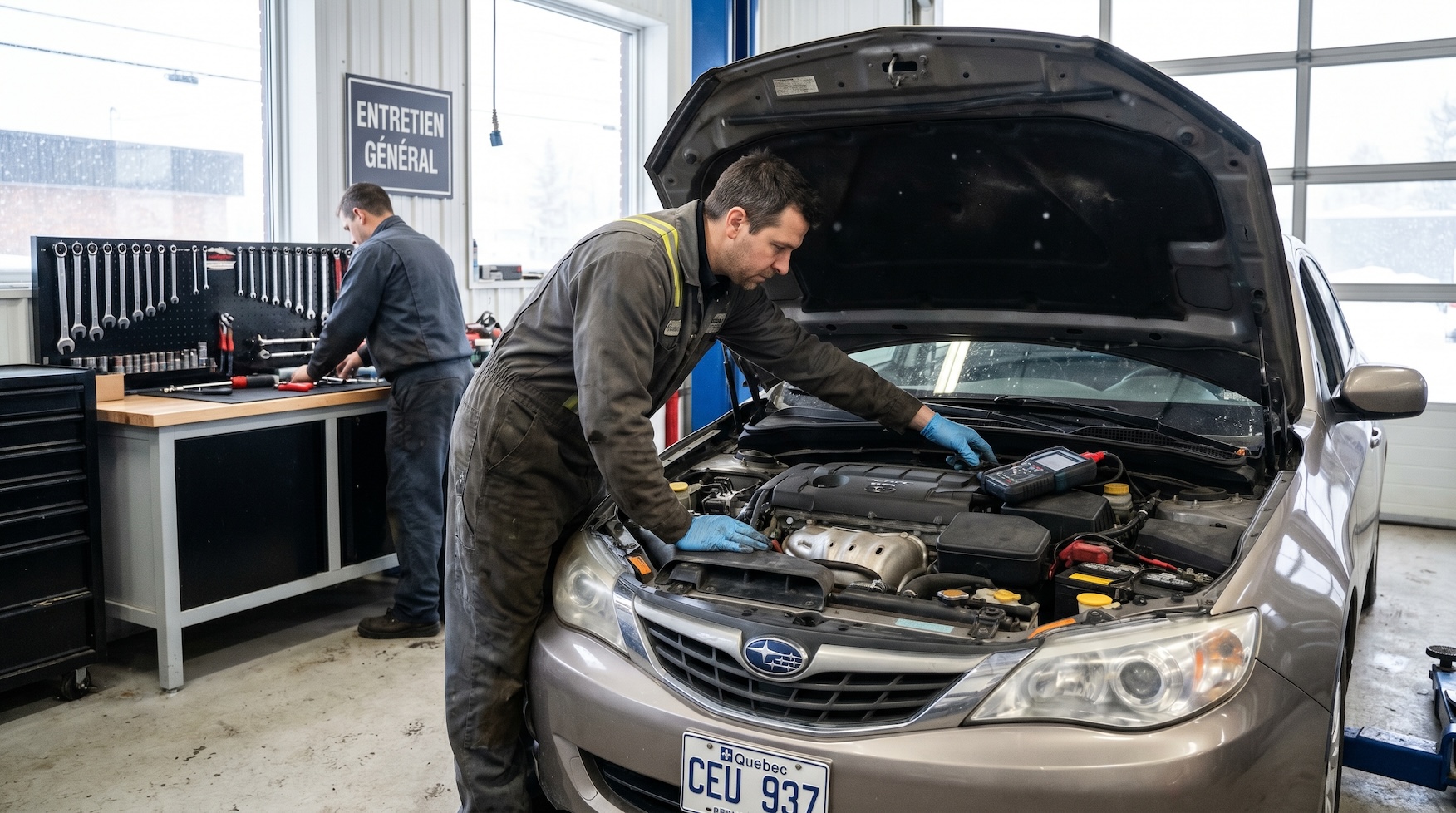
- Load Test: This tests the battery’s ability to deliver power under stress. While you can buy a load tester, most drivers rely on a garage. A professional load test applies a simulated load and measures voltage drop.
- Charging System Test: A garage will test the alternator to ensure it is providing between 13.8 and 14.4 volts to charge the battery while the engine runs. If the alternator is faulty, a new battery will quickly die again.
Decision Rule: Replace or Diagnose?
- Replace if: The battery is 4+ years old, fails a load test, or shows physical damage like a swollen case.
- Diagnose further if: The battery is relatively new (under 3 years), tests at 12.6V but drains overnight, or if the car dies while driving (strong indicator of an alternator or parasitic drain issue).
Drivers of Car Battery Replacement Cost
Several factors dictate the final price you pay for a battery replacement in Quebec:
- Battery Type: Standard flooded batteries are the most affordable. AGM batteries, required for vehicles with start-stop systems or high electrical demands, cost significantly more.
- Cold Cranking Amps (CCA): Batteries designed for extreme cold have higher CCA ratings. For Quebec, a battery with a CCA rating suited for -30°C or lower is highly recommended, which increases the cost compared to a lower-rated battery.
- Warranty: Batteries with longer replacement warranties (e.g., 5-year vs. 3-year) carry a higher upfront cost but offer better long-term value.
- Vehicle Make and Model: Luxury vehicles, SUVs with large engines, and vehicles requiring specific battery placements (like under the rear seat) often require more expensive batteries and higher labour costs.
Failure Modes: Stop Guessing and Call a Garage
There are clear scenarios where attempting a DIY diagnosis or replacement is unwise, and professional intervention is required:
- Repeated Failures: If you jump-start the vehicle and it dies again shortly after, or if it needs frequent jumps over a few days, the problem is likely not a simple dead battery.
- Burning Smell: A smell of burning rubber or electrical components under the hood suggests a seized alternator or a severe electrical short. Do not attempt to start the vehicle.
- Visible Leaks or Swelling: A battery case that is visibly swollen or leaking acid requires immediate professional handling due to chemical hazards.
- Parasitic Drain: If a load test and alternator test are normal, but the battery goes flat overnight, the vehicle has a parasitic draw (an electrical component failing to shut off). Diagnosing this requires specialized tools and systematic circuit testing best left to a mechanic.
How CarZen Helps Quebec Drivers
CarZen is an automotive maintenance marketplace that connects drivers with local garages for vehicle servicing. For battery issues, CarZen helps you compare quotes for testing and replacement from verified shops in your area. Whether you need a mobile mechanic to boost and test your car in your driveway, or a local garage for a full charging system diagnosis, CarZen provides the platform to find and book those services. Final diagnosis, parts selection, and warranties are always confirmed directly with the service provider.
Checklist: Preparing Your Battery for Winter
Use this checklist to minimize the risk of a dead battery this winter:
- [ ] Check the battery manufacture date. Replace it if it is older than 4 years.
- [ ] Ensure terminals are clean, tight, and free of corrosion.
- [ ] Verify the battery is securely fastened to prevent vibration damage.
- [ ] Have a professional test the battery’s CCA performance and overall health.
- [ ] Test the alternator output to confirm the charging system is working correctly.
- [ ] Plug in your block heater when temperatures drop below -15°C to reduce engine strain during start-up.
Frequently asked questions
How long does a car battery typically last in Quebec?
Due to extreme temperature fluctuations and harsh winters, a car battery in Quebec typically lasts between 3 and 5 years. Regular testing is recommended after the third year.
Do I need to replace my car battery if it dies once in the winter?
Not necessarily. A single dead battery may just be drained from sitting or an interior light being left on. Test the battery and the vehicle's charging system to determine if it holds a charge before replacing it.
Can extreme cold permanently damage a car battery?
Yes. If a battery is discharged or old, the electrolyte solution inside can freeze. Frozen electrolytes expand, which can warp the internal plates or crack the battery casing, permanently destroying the battery.
Is it cheaper to replace a battery myself?
DIY replacement can save you the labour cost, but you must factor in the core charge return and proper disposal of the old battery. Many garages include disposal in their installation fee, making the total cost difference minor.
What is the difference between CCA and CA (Cranking Amps)?
Cold Cranking Amps (CCA) measures the battery's ability to start an engine at -18°C (0°F). Cranking Amps (CA) measures this at 0°C (32°F). For Quebec winters, CCA is the most important rating to look at.