When to Test Your Car Battery Before Winter in Canada
Learn when to test your 12V car battery before a Canadian winter. Spot warning signs, check battery age, and know when to visit a garage for a replacement.
Quick answer
Test your car battery every fall before temperatures drop below freezing in Canada. Most batteries last three to five years. If yours is older than three years, have a garage perform a load test to confirm its health before winter arrives.
Key facts
- Market
- CA
- Average Battery Lifespan
- 3 to 5 years
- Critical Temperature Threshold
- Engine cranking power drops significantly at 0°C
- Ideal Pre-Winter Test State
- State of Charge above 12.4V resting
- Standard 12V Battery Voltages
- Fully charged at 12.6V; needs charging at 12.4V
Service boundaries
- CarZen helps Canadian drivers connect with local garages for seasonal maintenance, diagnostic testing, and battery replacements.
- Drivers can use the CarZen platform to compare quotes for battery testing and installation.
- A physical garage must perform the definitive load test and safely install a new battery.
- CarZen does not provide roadside emergency jump-starts or sell batteries directly.
What can change the price
- A standard 12V battery testing service is often complimentary when performed alongside other seasonal maintenance, but standalone diagnostic fees can range from $20 to $50.
- A new 12V car battery in Canada typically costs between $100 and $250. Premium AGM batteries required by many modern vehicles with start-stop systems can range from $200 to $400 or more.
- Total replacement costs depend heavily on the vehicle make, battery type, labour rates, and environmental disposal fees mandated by Canadian provinces.
Sources and useful pages
Related CarZen services
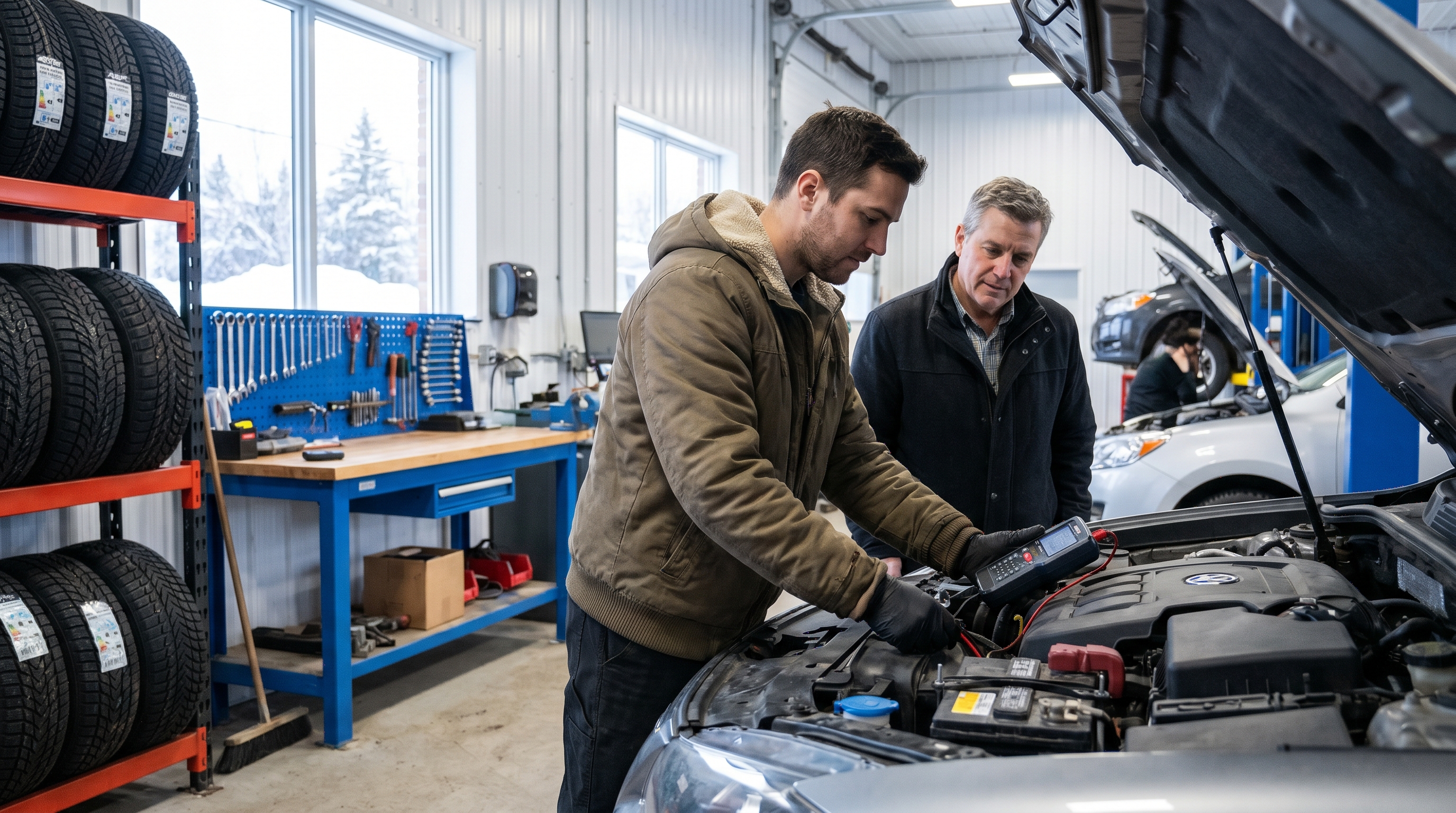
When Should Canadian Drivers Test Their Car Battery Before Winter?
Canadian drivers should test their 12V car battery annually before the first hard freeze, ideally in October or early November. A car battery loses a significant portion of its cranking power when temperatures drop to freezing, and a battery that performs fine at 10°C can easily fail to start your engine at -15°C. If your battery is older than three years, a professional diagnostic test is highly recommended before winter sets in.
Understanding the Impact of Canadian Winters on 12V Batteries
Car batteries do not actually die instantly from the cold; rather, the cold exposes their diminished capacity. At 0°C, a healthy battery operates at roughly 65% of its capacity, but it requires nearly twice the cranking amps to turn over an engine with cold, thick oil. This gap between reduced power and increased demand is why weak batteries fail in December and January.
A fully charged battery resists freezing down to approximately -76°C, but a partially discharged battery can freeze at -1°C. Freezing can physically crack the battery casing and destroy the internal cells. Testing ensures your battery has a full State of Charge (SOC) and structural integrity before the harsh weather hits.
When to Test or Replace Your Battery: A Decision Rule
Use this decision checklist to determine your next steps before winter:
- Check the Age: Locate the manufacture date sticker on the battery. If it is older than 4 years, plan for an immediate replacement.
- Listen to Engine Crank: Does the engine crank slowly or struggle to start in the morning? If yes, drive directly to a garage for a test.
- Measure Resting Voltage: If you have a multimeter, measure the battery after the car has sat overnight. At 12.6V it is fully charged. If it reads between 12.0V and 12.4V, it needs charging and a load test. Below 12.0V, it may have a bad cell.
- Inspect for Physical Damage: Look for swollen battery cases or corrosion on the terminals. White or greenish powder on the terminals can be cleaned, but a swollen case means the battery must be replaced immediately.
Key Symptoms of a Weak Charging System
Do not assume a morning no-start is purely a battery issue. The charging system must work together seamlessly. Look out for these interconnected symptoms:
- Slow Engine Crank: The engine turns over sluggishly, sounding like it is labouring.
- Dim Headlights: Headlights noticeably brighten when you rev the engine, indicating the battery is not maintaining a charge.
- Electrical Glitches: Infotainment systems rebooting, power windows operating noticeably slower, or dashboard warning lights (especially the battery icon) flickering.
- Rotten Egg Smell: A smell resembling rotten eggs near the battery indicates it is overcharging and venting sulfuric gases. This is a failure mode requiring immediate professional attention.
How a Garage Tests Your Battery
A visual inspection and a multimeter reading are not enough to guarantee winter reliability. Garages use specialized equipment to verify battery health definitively.
Conductance Testing vs. Load Testing
Most modern auto shops use a conductance tester. This device sends a small AC signal through the battery to measure the internal plate condition without requiring the battery to be fully charged. It outputs the Cold Cranking Amps (CCA) capacity and State of Health (SOH) as a percentage.
A traditional carbon pile load test applies a heavy electrical draw to simulate starting the engine. It measures how much the battery voltage drops under load. A healthy battery should not drop below 9.6 volts during a 15-second load test at room temperature.
Garages will also perform a charging system test to verify that the alternator is outputting the correct voltage (usually between 13.8V and 14.7V with the engine running) and that the drive belt is not slipping.
Illustrative Example
Illustrative example: Consider a driver in Edmonton with a 2018 SUV whose original battery is now six years old. In September, the vehicle starts perfectly. However, by late November, at -25°C, the engine cranks extremely slowly. The driver uses a multimeter and reads 12.2V, assuming the battery is fine. A garage performs a conductance test and reveals the State of Health is at 40% with heavy sulfation on the internal plates. The battery cannot sustain the high current required for winter starts. A new battery is installed, preventing the driver from being stranded during a morning commute.
Failure Modes and Exceptions: When to Stop Guessing
Automotive electrical systems are complex. There are specific scenarios where DIY diagnostics fail and professional intervention is strictly necessary:
- Parasitic Draw: If your battery repeatedly dies overnight, the issue is likely a parasitic draw (an electrical component failing to shut off). Tracking this down requires specialized tools and systematic fuse-pulling procedures at a garage.
- Alternator Failure: A failing alternator will destroy a brand-new battery by repeatedly draining it to zero. Always ensure the garage tests the alternator output before or alongside a battery replacement.
- AGM and Start-Stop Systems: Many modern vehicles use Absorbent Glass Mat (AGM) batteries designed to handle frequent engine restarts. Replacing an AGM battery with a standard flooded lead-acid battery will cause charging failures, trigger dashboard warnings, and shorten battery life. The vehicle may also require a computer reset to recognize the new battery.
- Rodent Damage: In both urban centers and rural areas, rodents can chew battery cables, causing high resistance that mimics a dead battery. This requires a garage to trace and repair the wiring safely.
If your vehicle exhibits intermittent starting issues, warning lights remain on after starting, or you smell burning plastic or sulfur, stop driving and have the vehicle towed to a service center.
How CarZen Helps Canadian Drivers with Winter Maintenance
CarZen connects drivers with trusted local garages across Canada for pre-winter inspections, diagnostic testing, and mechanical repairs. If your battery fails a winter readiness check, or if you need a complete seasonal overhaul, you can use CarZen to find local services, compare transparent quotes, and book appointments.
Whether you are looking for an autumn diagnostic check, an alternator inspection, or a complete battery replacement, the CarZen marketplace allows you to coordinate your automotive maintenance efficiently.
Preparing Your Vehicle for the Canadian Cold
Testing your battery is only one component of winter readiness. Cold temperatures drastically affect tire pressure, engine oil viscosity, and brake performance. Completing a comprehensive seasonal checklist ensures your vehicle remains safe and reliable on icy and snow-packed roads. Scheduling a multi-point inspection at a CarZen-partnered garage can help catch these issues before they become hazardous.
Frequently Asked Questions
At what temperature do car batteries start struggling in Canada?
Engine cranking power begins to drop noticeably at 0°C, and battery capacity decreases significantly as temperatures approach -15°C to -20°C. Testing your battery in early autumn ensures it is prepared for these rapid temperature drops.
Can I test a car battery myself?
You can check the resting voltage using a multimeter to see if it is around 12.6V. However, a voltage reading alone cannot confirm if the battery can sustain the heavy current draw required to start an engine in freezing weather. A professional load or conductance test is the only reliable indicator of winter readiness.
How long do car batteries typically last in Canada?
Due to extreme temperature fluctuations between harsh winters and hot summers, the practical average lifespan of a car battery in Canada is approximately 3 to 5 years. Frequent short trips that prevent the battery from fully recharging can shorten this lifespan.
Does a completely dead battery need to be replaced immediately?
If a battery is completely discharged and will not hold a charge even after being jumped and driven for an hour, it likely has a damaged cell and must be replaced. Repeatedly draining a 12V battery to zero volts causes permanent sulfation, heavily reducing its capacity and lifespan.
Frequently asked questions
At what temperature do car batteries start struggling in Canada?
Engine cranking power begins to drop noticeably at 0°C, and battery capacity decreases significantly as temperatures approach -15°C to -20°C. Testing your battery in early autumn ensures it is prepared for these rapid temperature drops.
Can I test a car battery myself?
You can check the resting voltage using a multimeter to see if it is around 12.6V. However, a voltage reading alone cannot confirm if the battery can sustain the heavy current draw required to start an engine in freezing weather. A professional load or conductance test is the only reliable indicator of winter readiness.
How long do car batteries typically last in Canada?
Due to extreme temperature fluctuations between harsh winters and hot summers, the practical average lifespan of a car battery in Canada is approximately 3 to 5 years. Frequent short trips that prevent the battery from fully recharging can shorten this lifespan.
Does a completely dead battery need to be replaced immediately?
If a battery is completely discharged and will not hold a charge even after being jumped and driven for an hour, it likely has a damaged cell and must be replaced. Repeatedly draining a 12V battery to zero volts causes permanent sulfation, heavily reducing its capacity and lifespan.