Check Engine Light Diagnosis in Quebec: What a Scan Can and Cannot Tell You
Learn what a diagnostic scan can and cannot prove when your check engine light turns on. Understand when to stop driving and how to prepare for your garage v...
Quick answer
A diagnostic scan reads stored trouble codes from your vehicle's computer, pointing to the system with a potential issue. It does not instantly identify the exact broken part. If the light flashes, the engine loses power, or you smell fuel or burning, pull over safely and stop driving immediately.
Key facts
- Market
- CA-QC (Quebec)
- Primary Scope
- Driver action and information recording
- Regulatory Scope
- Quebec provincial roadworthiness
- Scan Capability
- Reads generic and manufacturer-specific trouble codes
- Scan Limitation
- Cannot confirm the exact root cause without physical inspection
Service boundaries
- CarZen helps Quebec drivers compare local garages, request quotes for specific repairs, and understand automotive services.
- CarZen technicians can perform system scans and provide a report on the codes present.
- A diagnostic scan report shows potential problem areas, but CarZen cannot guarantee the exact root cause without a full physical inspection.
- CarZen does not issue mechanical inspection certificates or SAAQ-specific approvals, which must be handled by an authorized facility.
What can change the price
- Diagnostic scan fees in Quebec typically range from $0 to $150. The cost varies based on whether the scan is a basic OBD-II code read, a full system deep-dive, or waived entirely if the customer proceeds with a repair at that specific garage.
- Estimates and final repair costs depend heavily on the exact vehicle make, model, year, parts availability in Canada, and current labor rates.
Sources and useful pages
Related CarZen services
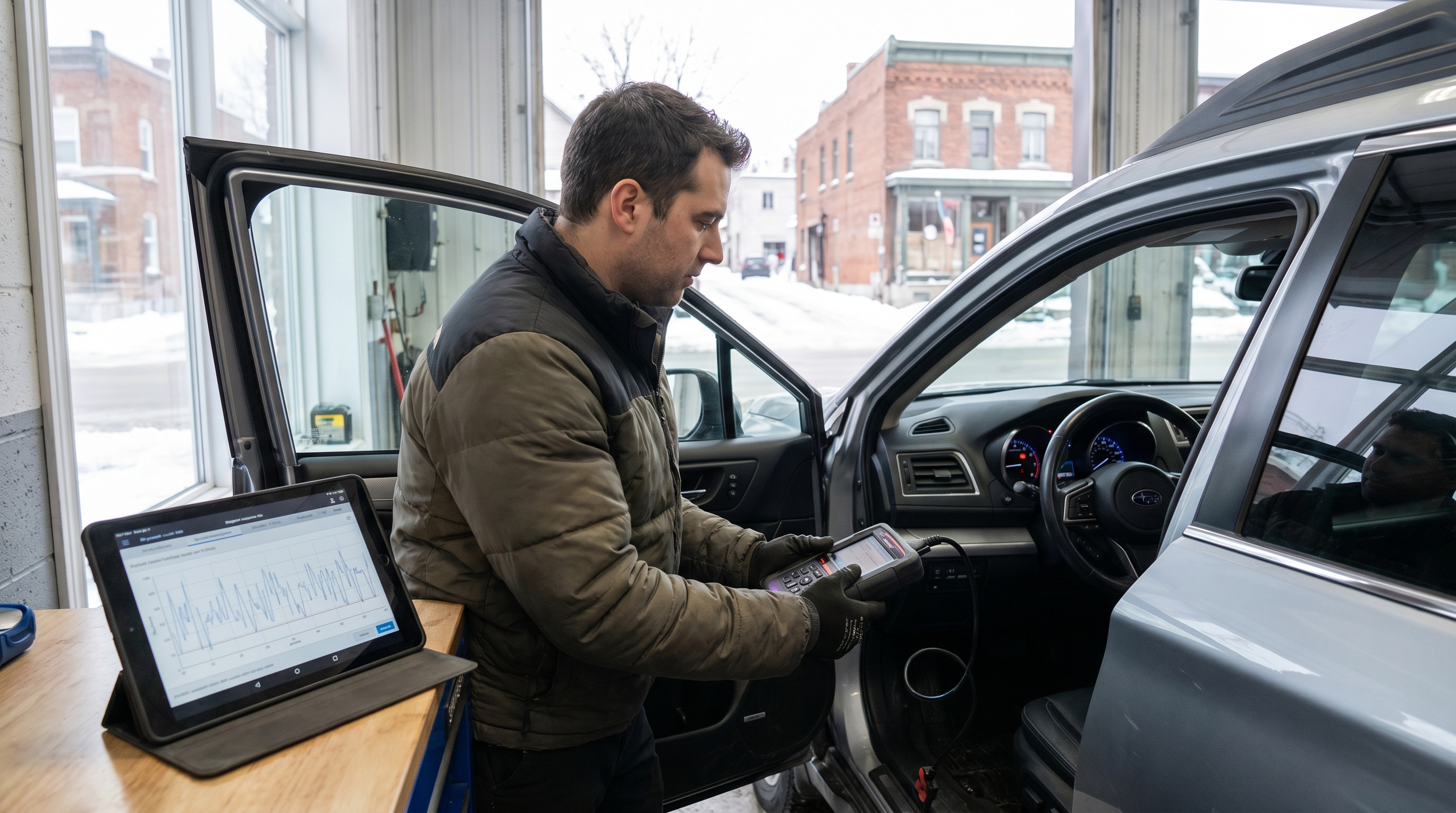
What a Diagnostic Scan Actually Does
A check engine light diagnosis in Quebec begins with an OBD-II (On-Board Diagnostics) scan. This scan retrieves alphanumeric trouble codes stored in your vehicle’s computer system. These codes indicate which system or component triggered the warning. For example, a P0420 code points to catalyst system efficiency, while a P0301 indicates a misfire in cylinder one. The scan is the critical starting point, but it cannot prove the exact cause of the problem. A misfire code might result from a worn spark plug, a failed ignition coil, or a fuel injector issue. Further physical testing is required to isolate the root cause.
For drivers in Quebec dealing with an unexpected “diagnostic voyant moteur” issue, understanding this distinction prevents misdiagnosing the vehicle and buying unnecessary parts. The diagnostic scan points to the neighborhood; the mechanic must find the specific house.
When to Stop Driving Immediately
While a solid check engine light requires a prompt diagnosis, a flashing check engine light signals an active, severe problem that could cause immediate damage to your engine or catalytic converter. In these situations, continuing to drive is a significant risk.
Pull over safely and arrange for a tow if you experience any of the following:
- The check engine light is flashing or blinking consistently.
- You notice a sudden and significant loss of engine power or rough idling.
- You smell raw fuel, burning oil, or an unusual sulfurous (“rotten egg”) odor.
- You hear loud, abnormal metallic noises like knocking or clattering from the engine block.
- Your temperature gauge spikes sharply, indicating the engine is overheating.
Ignoring these symptoms can lead to costly damage, turning a simple sensor replacement into a major engine overhaul. Road safety remains a priority; if the vehicle cannot maintain safe highway speeds, it poses a risk to you and other drivers.
What to Record Before Your Garage Visit
Accurate information speeds up the diagnostic process and helps your mechanic. Before bringing your vehicle in for a check engine light diagnosis, write down the following details:
- Symptoms: Note exactly how the vehicle drives differently. Is the idle rough? Is there a hesitation during acceleration? Does the problem occur only when the engine is cold?
- Trigger Conditions: Were you driving on the highway, stopped in traffic, or starting the engine in extreme Quebec winter weather when the light appeared?
- Recent History: Mention any recent work done on the vehicle. Even simple tasks like replacing the battery, refueling with a new gas station’s fuel, or driving through a deep puddle can be relevant.
- Code Details: If you used a consumer-grade code reader, write down the exact code(s) (e.g., P0171) rather than just the brief description on the scanner screen.
Diagnostic Scan Checklist: What a Code Can and Cannot Tell You
Use this decision checklist to manage expectations during your check engine light diagnosis:
What a Diagnostic Scan CAN Prove
- Confirm that the vehicle’s computer has detected a fault in a specific system.
- Identify the exact alphanumeric trouble code(s) set by the computer.
- Provide live data parameters (like engine RPM, coolant temperature, and sensor voltages) to help assess system performance.
- Clear the codes to see if the issue immediately returns during a test drive.
What a Diagnostic Scan CANNOT Prove
- Identify the exact, singular failed part without further physical testing.
- Reveal physical mechanical damage not monitored by sensors (e.g., a hairline crack in a hose or a completely rusted exhaust component).
- Guarantee that replacing the component mentioned in the code description will fix the vehicle.
- Substitute for a comprehensive visual and mechanical inspection.
Failure Modes: When to Stop Guessing
Diagnosing modern vehicles is complex. The primary failure mode drivers encounter is over-relying on the initial OBD-II code. Many Quebec drivers make the mistake of looking up a code online and immediately replacing the sensor mentioned in the code description. For instance, an oxygen sensor code might actually be caused by an exhaust manifold leak, or a mass airflow sensor code could be triggered simply by a clogged, dirty air filter that needs replacement.
Stop guessing and call a garage through a trusted platform like CarZen when:
- The vehicle has multiple unrelated codes that keep coming back after being cleared.
- The primary symptom changes or worsens (e.g., rough idle turns into engine stalling).
- You replaced the part indicated by the code, but the check engine light returns immediately.
- Your vehicle is subject to an upcoming SAAQ mandatory inspection (for older vehicles or specific classes) and must pass strict roadworthiness criteria.
Repeatedly guessing and replacing parts is more expensive in the long run than paying for a professional diagnosis upfront. Authorized mechanics have the experience, specialized tools, and technical service bulletins required to properly interpret the diagnostic data.
How CarZen Helps Quebec Drivers
CarZen simplifies the process of managing unexpected car repairs. If your check engine light is on, CarZen helps you compare local garages in Quebec, understand the typical scope of a diagnostic service, and submit requests for quotes.
When you use CarZen, you gain access to a network of automotive professionals. A garage can perform the necessary OBD-II scan, evaluate the specific codes, and conduct the required physical tests to give you an accurate, transparent estimate for the repair. CarZen facilitates the connection and helps you find the right service for your needs, ensuring you are informed before authorizing any major work.
Frequently asked questions
Will a diagnostic scan tell me exactly what part to replace?
No. A scan provides a trouble code that points to the system experiencing an issue (such as fuel, air, or ignition). Physical testing by a mechanic is necessary to isolate the exact failed component.
Is it illegal to drive with the check engine light on in Quebec?
A solid check engine light does not automatically mean your vehicle is illegal to drive, but it indicates a problem that could affect emissions or safety. If your vehicle requires a mechanical inspection, unresolved check engine codes will result in a failure.
Can extreme cold weather in Quebec trigger a check engine light?
Yes. Extreme cold can cause sensors to read temporarily out of range, or expose weak components like aging batteries and brittle vacuum hoses, triggering a light. However, a professional scan is still required to determine if the issue is temporary or requires repair.
Can I perform a check engine light diagnosis myself?
You can use a basic consumer OBD-II code reader to retrieve the generic trouble codes. This provides helpful starting information, but it is not a complete diagnosis. You will still need a professional mechanic to interpret the live data and perform physical tests.
Why did my mechanic charge for a diagnostic scan even if I already knew the code?
Knowing the code is only the first step. The diagnostic fee covers the mechanic's time and expertise to verify the code, analyze live sensor data, perform physical pinpoint tests, and accurately determine the root cause of the problem.