Engine Coolant Freeze Protection in Canada: Testing, Strength, and When to Stop Guessing
Learn how to test and maintain engine coolant freeze protection for Canadian winters. Covers mixture strength, testing methods, and why colour is not enough.
Quick answer
Engine coolant freeze protection in Canada requires a 50/50 mix of antifreeze and water, protecting to roughly -37°C. Test protection with a hydrometer or refractometer before winter. Do not rely on coolant colour alone, as it does not indicate type or strength. Replace degraded coolant to prevent engine block cracking.
Key facts
- Market
- CA
- Minimum recommended freeze protection
- -35°C to -45°C for most of Canada
- Standard mixture ratio
- 50/50 antifreeze to water
- Maximum practical mixture
- 70/30 antifreeze to water (protects to ~-52°C)
- Safe testing tools
- Coolant hydrometer or optical refractometer
Service boundaries
- CarZen helps Canadian drivers connect with qualified garages for coolant testing, flushes, and replacement.
- CarZen marketplace listings provide estimates, but a physical garage must test your specific coolant and confirm its condition and freeze protection rating.
- Diagnosing internal coolant leaks, head gasket failures, or heater core issues requires in-garage inspection and is outside CarZen's direct diagnostic scope.
What can change the price
- Coolant hydrometer testers typically cost between $10 and $30 CAD at Canadian auto parts stores.
- A professional coolant drain and refill at a Canadian garage generally ranges from $100 to $200 CAD, depending on the vehicle's make, model, and the specific coolant type required.
- A full cooling system flush may range from $150 to $300 CAD, with price fluctuations driven by regional labor rates and the total fluid capacity of the cooling system.
Sources and useful pages
Related CarZen services
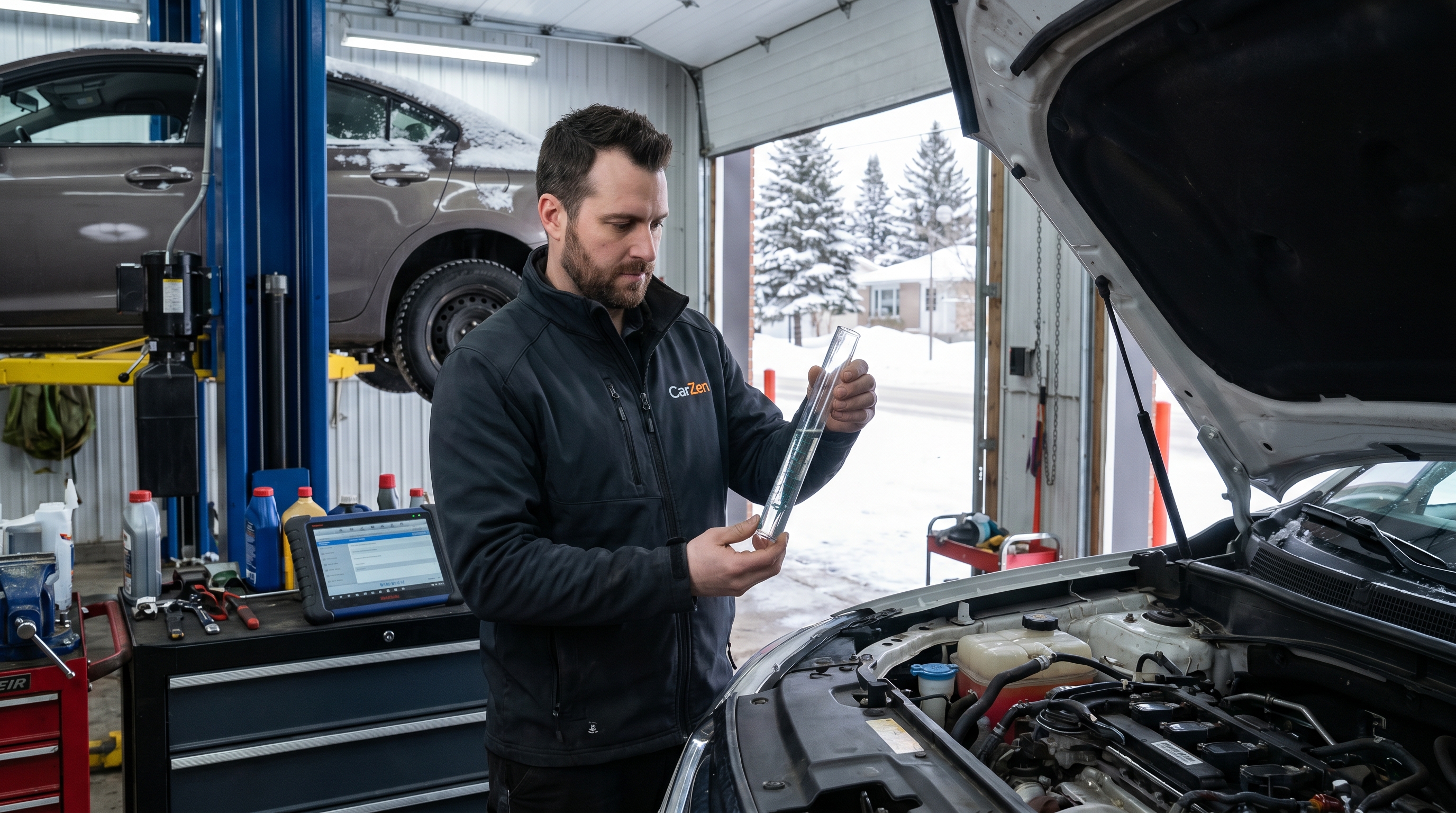
What is Engine Coolant Freeze Protection?
Engine coolant freeze protection is the ability of your vehicle’s antifreeze mixture to remain liquid and continue flowing at sub-zero temperatures. In Canada, where temperatures routinely drop well below -30°C, maintaining the correct antifreeze-to-water ratio is critical. If the coolant freezes, it expands. This expansion can crack the engine block, burst radiator hoses, or destroy the heater core. Ensuring proper freeze protection (protection antigel du liquide de refroidissement au Canada) is a fundamental aspect of seasonal vehicle maintenance.
How Freezing Damages an Engine
Coolant flows through the engine block and cylinder head, absorbing combustion heat and carrying it to the radiator. Water is highly efficient at heat transfer but freezes at 0°C and boils at 100°C. Ethylene glycol or propylene glycol (the active ingredients in antifreeze) is added to lower the freezing point and raise the boiling point. When water freezes, it expands by roughly 9%. Inside the confined passages of an engine, this expansion generates immense pressure, shearing off hose connections, cracking aluminium or cast iron components, and causing catastrophic engine failure.
Why Canadian Drivers Should Not Rely on Coolant Colour
One of the most persistent maintenance myths is that coolant colour dictates its chemical composition, vehicle compatibility, or freeze protection rating. This assumption is incorrect and potentially dangerous.
Colour is Just a Dye
Manufacturers add dyes to coolant to help mechanics and drivers identify leaks under the hood. The colour does not communicate the chemistry of the fluid. There is no universal, legally enforced standard that maps a specific colour to a specific type of antifreeze.
- Green: Historically associated with traditional Inorganic Acid Technology (IAT) coolants, commonly used in older North American vehicles. However, some modern Organic Acid Technology (OAT) or Hybrid Organic Acid Technology (HOAT) coolants are also dyed green.
- Orange: Frequently associated with GM’s Dex-Cool (an OAT coolant), but other manufacturers use orange dye for entirely different chemical formulations.
- Pink/Red: Often indicates an OAT or P-OAT (Phosphated Organic Acid Technology) coolant, widely used in Asian and some European vehicles.
- Blue: Common in Asian vehicles (often P-OAT), but some European vehicles use blue for specific HOAT formulations.
- Clear or Yellow: Some universal or specific-brand coolants may appear clear or yellowish.
Mixing different chemical coolant types—regardless of colour—can cause the additives to precipitate, forming a sludge that clogs the radiator and heater core, reducing freeze protection and cooling efficiency. Always verify the coolant type by consulting the owner’s manual, not by looking at the colour in the overflow reservoir.
Testing Coolant Freeze Protection
To know your coolant’s freeze protection level, you must measure the ratio of glycol to water. Do this before the first deep freeze of the season.
1. Coolant Hydrometer
A coolant hydrometer is a plastic syringe with an internal float. You draw coolant into the syringe, and the float rises to a level indicating the freezing point. These cost around $10 to $20 CAD at Canadian auto parts stores. They are simple but can be difficult to read accurately and must be flushed with clean water after every use to maintain accuracy.
2. Optical Refractometer
An optical refractometer is a precision tool that measures how light bends as it passes through the coolant. You place a drop of fluid on the prism, look through the eyepiece, and read the freezing point on the internal scale. Refractometers are more accurate than hydrometers and cost roughly $20 to $50 CAD. They require periodic calibration using distilled water.
When to Test Coolant
Test your coolant in October or November, before ambient temperatures consistently drop below 0°C. You should also test the coolant whenever you purchase a used vehicle, as you cannot verify its maintenance history or what fluids were previously added.
Understanding Mixture Strength
The baseline ratio for Canadian winters is a 50/50 mixture of antifreeze and distilled water.
50/50 Mixture (The Standard)
A 50/50 blend provides freeze protection down to approximately -37°C and boil-over protection up to roughly 106°C (with a properly functioning radiator cap maintaining 15 psi). This is the standard recommendation for most passenger vehicles driven across Canada.
70/30 Mixture (The Maximum)
Increasing the antifreeze ratio to 70% antifreeze and 30% water lowers the freeze point to roughly -52°C. However, you should not exceed a 70/30 ratio. Pure antifreeze actually freezes at a higher temperature than a 50/50 mixture and transfers heat much less effectively. Over-concentrating the coolant can cause the engine to run hot in the summer, as the fluid cannot absorb heat efficiently.
Using Pre-Mixed vs. Concentrated Coolant
Pre-mixed 50/50 coolant is convenient and eliminates the risk of mixing errors. Concentrated coolant is more cost-effective if you are performing a full system flush, but it must be diluted with an equal volume of distilled water—never tap water, which contains minerals that cause scaling and corrosion inside the cooling system.
Illustrative example: A driver in Saskatoon buys a bottle of concentrated green coolant on sale. In a rush, they pour the entire jug into the radiator without mixing it with distilled water. The system, which still held a large volume of water, now has a diluted mixture. When temperatures drop to -35°C in January, the radiator freezes and cracks. The driver skipped the testing step and incorrectly assumed that adding “pure” antifreeze guaranteed maximum protection.
Warning Signs of Coolant Degradation or Failure
Coolant does not last forever. Over time, the corrosion inhibitors deplete, the glycol breaks down, and the fluid can become acidic, eating away at aluminium radiators and engine components. Watch for these signs:
- Discoloration or Rust: If the coolant looks brown, rusty, or has floating particles, the corrosion inhibitors have likely failed.
- Sludge or Oil Sheen: A thick, milky sludge indicates that engine oil is mixing with the coolant, often pointing to a failed head gasket or cracked engine block.
- Sweet Smell Inside or Outside the Cabin: Ethylene glycol has a distinct sweet smell. Smelling it indicates a leak.
- Frequent Low Coolant Warnings: The cooling system is sealed. If you constantly need to top it up, there is a leak.
- Heater Blowing Cold Air: The heater core is not receiving hot coolant, often caused by a clog from degraded coolant or a severe leak.
- Engine Temperature Gauge Spiking: If the temperature gauge runs higher than normal, the degraded coolant may no longer be absorbing heat effectively.
Failure Modes and When to Stop Guessing
Where This Advice Breaks
This guidance applies to standard passenger cars and light trucks under normal driving conditions. The advice breaks down under the following circumstances:
- Severe Leaks: If the coolant level drops rapidly, adding more fluid will not solve the underlying mechanical issue.
- Contaminated Systems: If the coolant resembles chocolate milk, the system is contaminated with oil or transmission fluid. Simply draining and refilling will not clean the internal passages.
- Electric Vehicles (EVs): Many EVs use a completely different thermal management fluid. Never add standard automotive ethylene glycol to an EV cooling system unless explicitly specified by the manufacturer.
When to Call a Garage
Stop guessing and book a garage appointment immediately if:
- You suspect a head gasket failure (white exhaust smoke, milky oil cap).
- The coolant is brown, chunky, or smells burnt.
- The vehicle consistently overheats even after topping up the coolant.
- You cannot safely access the radiator drain valve or bleed the air from the system.
How CarZen Helps Canadian Drivers
CarZen is an automotive maintenance marketplace that connects Canadian drivers with trusted local garages for routine seasonal maintenance. Through CarZen, you can compare shops for specific services like cooling system diagnostics, coolant flushes, and radiator repairs.
While CarZen provides service descriptions, pricing estimates, and booking tools, a physical garage must perform the hands-on testing and diagnosis. CarZen does not independently verify the chemical composition of your vehicle’s fluid or provide mobile laboratory analysis. For definitive answers on coolant condition, a mechanic must draw a sample from the vehicle and test it using professional equipment.
Coolant Winterization Checklist
Before temperatures drop below freezing, run through this checklist:
- [ ] Test the coolant freeze point using a hydrometer or refractometer.
- [ ] Confirm the freeze point is at least -35°C (lower if you live in a severe climate like the Prairies or Northern Quebec).
- [ ] Inspect the radiator, hoses, and clamps for visible cracks, swelling, or leaks.
- [ ] Verify that the coolant colour and type match the specification in your owner’s manual.
- [ ] Ensure the coolant level is between the “MIN” and “MAX” lines on the overflow reservoir when the engine is completely cold.
- [ ] Schedule a coolant flush if the fluid is more than 5 years old or shows signs of visual degradation.
Frequently asked questions
Does the colour of my coolant tell me what type it is?
No. Colour is just a dye added by the manufacturer and does not reliably indicate the chemical formulation or compatibility. Always check your owner's manual to verify the required coolant type.
What is the ideal antifreeze-to-water ratio for Canadian winters?
A 50/50 mixture of antifreeze and distilled water is the standard recommendation for most of Canada, providing freeze protection to approximately -37°C. Do not exceed a 70/30 ratio, as pure antifreeze freezes at a higher temperature and cools the engine poorly.
How often should engine coolant be replaced?
Most manufacturers recommend replacing coolant every 5 years or 100,000 to 150,000 kilometres, but this varies significantly by vehicle make and model. Test the fluid annually and replace it if the freeze protection is weak or the fluid is visibly degraded.
Can I use regular tap water to mix with concentrated antifreeze?
No. You should use distilled water. Tap water contains minerals and calcium that can form scale and deposits inside the radiator and engine block, reducing cooling efficiency and causing corrosion.
What happens if my coolant freezes?
If coolant freezes, it expands. This expansion can crack the engine block, burst the radiator, or rupture heater core pipes, leading to catastrophic engine failure and expensive repairs.