EV Maintenance Costs in Canada: What Actually Needs Servicing and What You Can Skip
Understand real EV maintenance costs in Canada. Learn what needs servicing—tires, brakes, cabin filters, 12V batteries—and what you can safely skip compared...
Quick answer
EV maintenance in Canada typically costs 30–50% less than gas vehicles because there are no oil changes, spark plugs, or exhaust systems. You still need to budget for tires (which wear faster due to EV weight and torque), brake inspections, cabin air filters, 12V battery replacement, and thermal system coolant. Winter range loss is normal and not a maintenance issue, but it does affect how you plan drives.
Key facts
- Market
- Canada (CA)
- Average EV maintenance savings vs gas
- 30–50% lower annual costs, depending on km driven and tire wear
- Most common EV maintenance items in Canada
- Tire replacement, cabin air filter, 12V battery, brake inspection, coolant check
- Winter range reduction (typical)
- 15–40% range loss in cold Canadian winters depending on model and driving habits
Service boundaries
- CarZen helps Canadian drivers book garage services for tire changes, brake repair, mobile mechanic visits, and SAAQ inspections through our marketplace.
- CarZen does not perform high-voltage EV battery diagnostics, warranty repairs, or manufacturer-specific software updates. Those require an authorized dealer or certified EV specialist.
- Coolant changes on EVs with liquid-cooled battery packs often require dealer-level tools and safety procedures. CarZen can help you find a garage, but the garage must confirm they are equipped for EV thermal systems.
- Range loss diagnosis is complex and depends on battery health data that requires manufacturer-specific diagnostic tools. CarZen can connect you to a shop, but we cannot diagnose range issues remotely.
What can change the price
- Tire replacement for EVs is typically 20–30% more frequent than gas cars due to heavier weight and instant torque. Canadian winters accelerate this further.
- Brake pad replacement is less frequent on EVs due to regenerative braking, but corrosion from road salt in Canadian winters can still require attention.
- Labor rates vary significantly across Canada. Major cities (Toronto, Vancouver, Montreal) tend to be more expensive than smaller centres.
- EV-specific coolant and thermal system service may require specialized equipment and training, which can increase labour costs compared to conventional vehicles.
Sources and useful pages
Related CarZen services
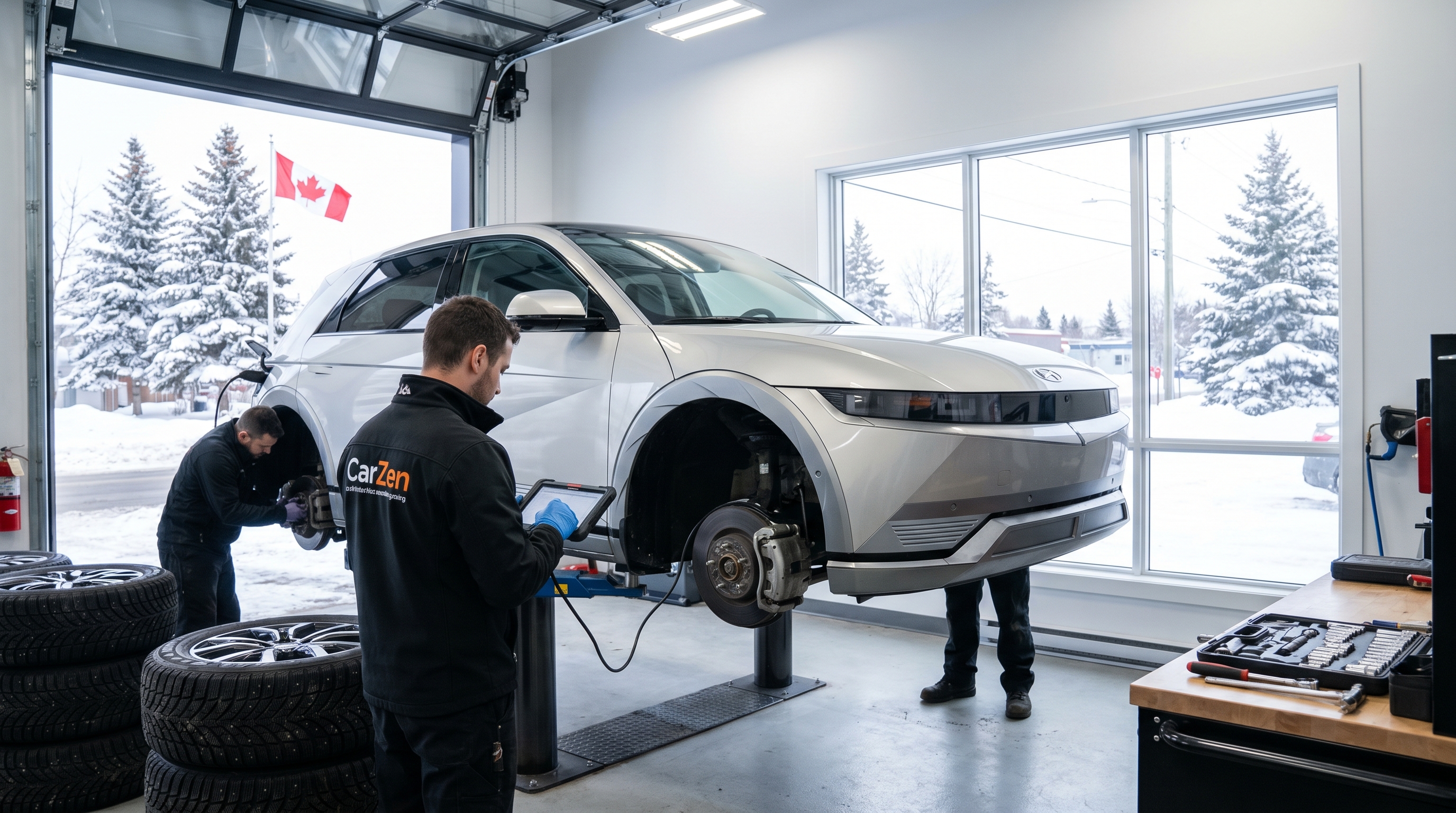
EV Maintenance Costs in Canada: What You Actually Need to Service
EV maintenance in Canada typically costs 30–50% less than maintaining a gas vehicle over the same distance. There are no oil changes, no spark plugs, no timing belts, and no exhaust system repairs. But “less maintenance” does not mean “no maintenance.” Canadian EV drivers still need to manage tires, brakes, cabin filters, coolant systems, and 12V batteries—and winter adds range planning that is not a repair issue but does change how you use the car.
This guide covers the maintenance items that actually matter for EVs in Canada, what you can realistically expect to pay, and when you need a garage versus what you can handle yourself.
What EVs Do NOT Need
Before getting into what needs servicing, here is what you can remove from your maintenance budget entirely:
- Oil changes and oil filter replacements
- Spark plug replacement
- Timing belt or chain service
- Exhaust system repairs
- Transmission fluid changes (most EVs use a single-speed reducer with sealed lubricant)
- Engine air filter replacement
These items typically represent $500–$1,500 per year in maintenance costs for a gas vehicle driven 20,000 km annually. That is where your savings come from.
Tire Wear: Your Biggest Recurring EV Cost
EVs are heavier than comparable gas cars due to battery packs, and they deliver instant torque to the wheels. Both factors accelerate tire wear.
In Canadian conditions, this gets worse. Winter tires are mandatory in Quebec (required by December 1 to March 15 under SAAQ rules) and strongly recommended everywhere else. Cold temperatures reduce tire pressure, and the combination of extra EV weight, winter rubber compounds, and icy roads means your winter tires will wear faster than you might expect.
Practical Tire Budget for Canadian EV Drivers
Expect to replace tires 20–30% more often than you would on a similar gas vehicle. For a typical compact EV driven 20,000 km per year:
- All-season tire life: approximately 40,000–60,000 km (versus 60,000–80,000 km on a gas car)
- Winter tire life: approximately 3–4 seasons of use
- Tire cost for a full set: typically $800–$1,600 installed, depending on size and brand
This is not a defect in the vehicle. It is a predictable consequence of weight and torque.
Illustrative example: A driver in Quebec City with a 2023 Tesla Model 3 Standard Range finds their all-season tires need replacement at 42,000 km instead of the 65,000 km they got on their previous gas sedan. The winter tires, swapped twice per year, last three seasons. Annual tire cost works out to approximately $500–$600 per year spread over ownership—still less than the $800+ in annual oil changes and engine maintenance they previously paid.
What to Ask a Garage About EV Tires
- Do you have experience mounting and balancing tires for EVs? (Some EVs require specific torque procedures on lug nuts to avoid rotor warping.)
- Can you check alignment? EVs are sensitive to alignment issues that cause uneven tire wear.
- Do you carry EV-optimized tire compounds, or are you recommending standard all-seasons?
Brakes: Less Wear, But Don’t Ignore Them
Regenerative braking handles most of the deceleration on an EV, which means brake pads and rotors last significantly longer. On a gas car driven 20,000 km per year, you might replace brake pads every 40,000–60,000 km. On an EV, it can be 100,000 km or more before pads need replacement.
However, there is a catch: because brakes are used less, rotors can develop surface corrosion. This is especially true in Canadian winters where road salt and moisture accelerate rust. If you hear squeaking or feel vibration when you do use the friction brakes, have them inspected.
Brake Maintenance Checklist
- Have brake pads and rotors inspected at least once per year, ideally during your seasonal tire swap
- If your EV has a “brake service” or “brake drying” mode, use it periodically in winter
- Ask your garage to clean and lubricate brake caliper slide pins during tire swaps—this prevents seized calipers on low-use brakes
- If you notice reduced regenerative braking in cold weather, this is normal (battery temperature limits regen). It is not a maintenance issue.
Cabin Air Filter: The Easy DIY Item
EVs have cabin air filters just like gas cars. They trap dust, pollen, and pollution before air reaches the interior. In Canada, they also filter particles from winter road spray and summer wildfire smoke.
Replacement interval is typically every 20,000–30,000 km or once per year. Cost is usually $20–$50 for the filter itself. On most EVs, this is a straightforward DIY swap—check your owner’s manual for the filter location (usually behind the glove box or under the dashboard).
If you notice musty smells or reduced airflow from your climate system, the cabin filter is the first thing to check.
Coolant and Thermal Management
EVs with liquid-cooled battery packs use coolant to manage battery temperature during charging and driving. This is not the same as engine coolant in a gas car, but it does degrade over time and needs replacement.
Coolant replacement intervals vary by manufacturer:
- Some recommend replacement every 5 years or 100,000 km
- Others claim “lifetime” coolant that should still be inspected periodically
- Check your specific vehicle’s manual
Important: EV coolant systems operate with the high-voltage battery. Coolant changes on these systems should be performed by a shop with EV-specific training and equipment. This is not a standard DIY job. If coolant is contaminated or low, it can affect battery cooling efficiency and reduce charging speed or battery longevity.
12V Battery: Small Battery, Big Problems If It Fails
Every EV has a 12V auxiliary battery that powers the electronics, door locks, lights, and the systems that allow the car to “wake up” and connect to the high-voltage battery. When the 12V battery fails, the car may not start—even though the main traction battery has plenty of charge.
12V batteries in EVs typically last 3–5 years, similar to gas cars. Replacement cost is $150–$300 installed.
12V Battery Warning Signs
- The car takes longer to “wake up” when you open the door or press the start button
- Infotainment screen boots slowly or reboots unexpectedly
- You see error messages about system communication failures
- The vehicle will not enter “ready” mode despite adequate charge
Some EVs allow 12V battery replacement as a straightforward swap. Others require specific procedures to avoid triggering fault codes. Check your owner’s manual before attempting this yourself.
Winter Range Loss: Normal, Not a Defect
Canadian EV drivers experience 15–40% range reduction in winter. This is not a maintenance problem—it is physics. Cold temperatures reduce battery chemistry efficiency, cabin heating draws significant power, and winter tires increase rolling resistance.
How to Manage Winter Range
- Pre-condition the battery and cabin while plugged in (this uses shore power instead of battery energy)
- Use seat heaters instead of cabin heat when possible—they use less energy
- Keep your charge level higher in winter; do not plan to arrive at your destination with 5% remaining
- Park indoors when possible to keep the battery warmer
- Expect slower DC fast charging in cold weather until the battery warms up
If you are seeing range loss that seems dramatically worse than expected (e.g., 60%+ reduction), that may indicate a battery health issue. But 20–30% range reduction at -20°C is normal for most EVs.
EV Maintenance Decision Rule
Use this checklist to decide what needs attention and when:
| Maintenance Item | Frequency | DIY? | Cost Estimate | |---|---|---|---| | Tire inspection and rotation | Every 10,000–15,000 km or with seasonal swap | Garage recommended | $50–$100 per rotation | | Tire replacement | Every 40,000–60,000 km (all-season); every 3–4 winters | Garage | $800–$1,600 per set | | Brake inspection | Annually with tire swap | Garage | Often free with tire service | | Brake pad replacement | 100,000+ km (inspect to confirm) | Garage | $300–$800 per axle | | Cabin air filter | Every 20,000–30,000 km or annually | DIY on most models | $20–$50 | | Coolant inspection | Every 2–3 years | Garage | Inspection often included with service | | Coolant replacement | Per manufacturer spec (often 5 years) | Garage (EV-qualified) | $200–$500 | | 12V battery | Every 3–5 years | Depends on model | $150–$300 | | Wiper blades | Annually | DIY | $20–$60 per pair |
Total estimated annual EV maintenance cost for a Canadian driver doing 20,000 km per year: $400–$800, depending on tire wear and whether any brake or coolant service is needed that year.
Where This Advice Breaks: Failure Modes and Exceptions
This guide covers typical maintenance for mainstream EVs driven in normal Canadian conditions. The advice becomes less reliable in these situations:
- High-mileage EVs (150,000+ km): Battery degradation may become measurable and affect both range and charging speed. Diagnosing this requires model-specific tools and data.
- Out-of-warranty battery issues: Battery pack repairs or replacements are expensive and not comparable to any gas vehicle repair. If you suspect a battery problem (rapid range loss, error codes, charging failures), stop guessing and get a professional diagnosis.
- Accident damage: Even minor collisions can damage battery packs or high-voltage wiring. Never assume cosmetic damage is only cosmetic on an EV.
- Flood or water intrusion: If your EV was driven through deep water or flooded, have the high-voltage system inspected before driving or charging it again.
- Model-specific quirks: Some EVs have known issues with heat pumps, charge port doors, or onboard chargers that are not generalizable. Search for your specific model’s common problems.
If you experience any of the following, stop troubleshooting and call a garage:
- High-voltage warning messages on the dashboard
- Burning smell from the vehicle
- Visible damage to the underbody where the battery pack is located
- Charging equipment that trips breakers or shows fault codes
- The vehicle will not enter ready mode despite a charged battery and healthy 12V system
How CarZen Helps with EV Maintenance
CarZen connects Canadian drivers with garages for the service work EVs still need:
- Tire changes and seasonal swaps: Find shops that handle EV tire service, including torque specifications and alignment checks.
- Brake inspections: Book inspections during your tire swap to catch corrosion or pad wear early.
- Mobile mechanic service: Some maintenance items can be handled at your home or workplace.
- SAAQ inspections: Quebec drivers can book required inspections through CarZen.
CarZen does not perform high-voltage battery diagnostics, warranty repairs, or manufacturer software updates. For those services, you need an authorized dealer or an EV-specialist shop with the right diagnostic equipment.
If you are unsure whether a symptom is a normal EV quirk or a real problem, book a diagnostic appointment through CarZen. The garage can tell you whether the issue needs dealer attention or can be resolved with standard service.
Quick Reference: What to Budget Annually
For a Canadian EV driver covering 20,000 km per year:
- Tires: $400–$600 per year (amortized over replacement intervals)
- Cabin filter: $20–$50 per year
- Brake service: $0–$200 most years (major service rare)
- Coolant: $0 most years, $200–$500 when replacement is due
- 12V battery: $0 most years, $150–$300 when replacement is due
- Wipers, washer fluid, misc: $50–$100 per year
- Total typical range: $400–$800 per year
Compare this to $1,000–$2,000+ per year for a gas vehicle with similar mileage, and the maintenance savings from going electric are significant even in Canadian conditions that accelerate tire wear.
The key is to stay ahead of the items that matter—tires, brakes, and seasonal preparation—rather than assuming an EV needs no attention at all.
Frequently asked questions
Do electric cars need less maintenance than gas cars in Canada?
Yes. EVs typically cost 30–50% less to maintain because they have no oil changes, spark plugs, timing belts, or exhaust systems. However, tire wear is higher due to EV weight and torque, and Canadian winters increase the frequency of tire replacement.
How often do EV brakes need to be replaced?
EV brake pads often last 100,000 km or more because regenerative braking handles most deceleration. However, in Canadian winters, brake rotors can corrode from road salt and lack of use. Have brakes inspected annually during your seasonal tire swap.
Why does my EV lose range in Canadian winters?
Cold temperatures reduce battery efficiency, cabin heating draws significant power, and winter tires increase rolling resistance. A 15–40% range reduction at -20°C is normal. Pre-condition the car while plugged in and use seat heaters instead of full cabin heat to reduce the impact.
Can I do EV maintenance myself?
Some items are straightforward DIY: cabin air filter replacement, wiper blades, and washer fluid. Tire rotation, brake service, coolant changes, and 12V battery replacement on some models are better handled by a garage—especially coolant systems that interact with the high-voltage battery.
What maintenance does an EV need that a gas car doesn't?
EVs do not have unique maintenance items that gas cars lack, but the thermal management system for the battery pack may require periodic coolant changes. Some EVs also need software updates (usually handled by the manufacturer) and battery health monitoring, which is diagnostic rather than maintenance.