Fuel Efficient Driving and Maintenance in Canada: NRCan-Aligned Guide
Reduce fuel consumption with proven Canadian driving habits and maintenance routines. NRCan-aligned tips on tire pressure, idling, and servicing for real sav...
Quick answer
Fuel-efficient driving in Canada combines proper tire inflation, regular maintenance, smooth driving habits, and reduced idling to cut fuel consumption by 10-20%. Natural Resources Canada confirms these practices deliver measurable savings. Maintaining your vehicle through CarZen's network ensures your car operates at peak efficiency.
Key facts
- Market
- CA
- Fuel savings from eco-driving
- 10-20%
- Optimal tire pressure check frequency
- Monthly
- Cold weather tire pressure drop
- 1 psi per 5°C decrease
- Idling fuel waste estimate
- 0.5 to 1.2 litres per hour
Service boundaries
- CarZen connects drivers with garage partners for maintenance and inspections but does not perform mechanical work directly.
- Fuel consumption data and official efficiency ratings should be verified through Natural Resources Canada.
- Specific vehicle diagnostics, sensor failures, or warranty-covered repairs must be confirmed by a certified mechanic.
- CarZen pricing estimates are practical ranges based on market data; actual garage quotes depend on vehicle make, model, and location.
What can change the price
- Routine maintenance like oil changes and filter replacements range from $80 to $150 depending on synthetic vs conventional oil, vehicle type, and regional labor rates.
- Tire pressure checks are often free at service stations, while full tire service and seasonal changeovers typically range from $60 to $120 for a standard vehicle.
- Major fuel system services, such as fuel filter replacement or throttle body cleaning, can range from $100 to $300 depending on parts and labor complexity.
- Pricing does not include Quebec-specific tire taxes, environmental fees, or GST/QST, which vary by region and service type.
Sources and useful pages
Related CarZen services
Direct Answer: How to Improve Fuel Efficiency in Canada
Fuel-efficient driving in Canada is a combination of vehicle maintenance, driving behavior, and environmental adaptation. Natural Resources Canada (NRCan) data shows that eco-driving techniques alone can improve fuel efficiency by 10-20%. The most significant factors within a driver’s control are maintaining proper tire pressure, keeping up with scheduled maintenance (oil changes, air filters, spark plugs), avoiding aggressive acceleration and hard braking, and minimizing unnecessary idling. Canadian drivers face unique challenges, such as extreme cold weather dropping tire pressure and winter fuels containing slightly less energy density than summer blends, making consistent maintenance critical.
Decision Rules for Fuel-Efficient Driving
Prioritize Tire Pressure First
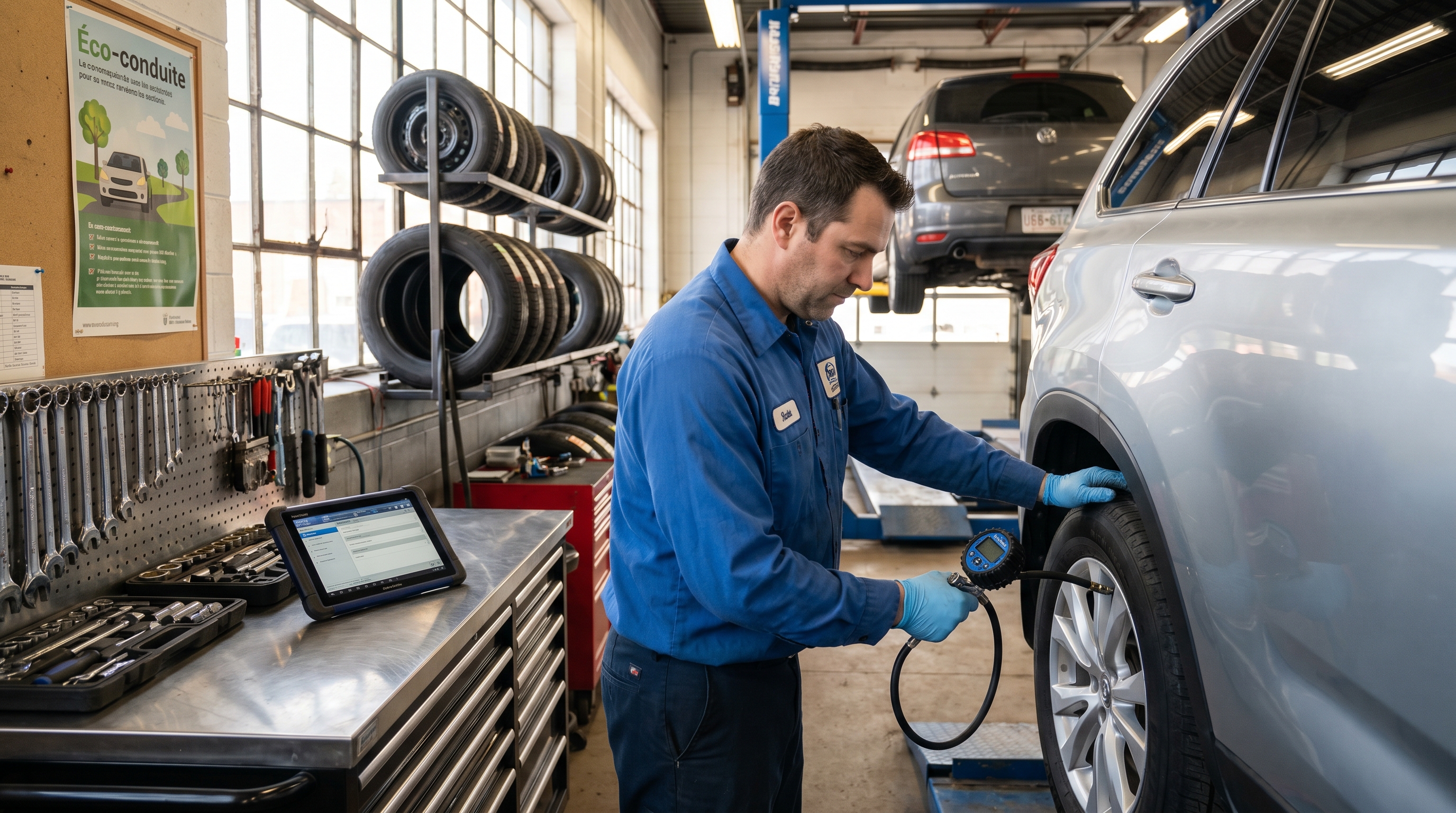
Under-inflated tires increase rolling resistance, forcing the engine to work harder. NRCan estimates that operating a vehicle with tires under-inflated by 8 psi (56 kPa) can increase fuel consumption by 4%. In Canada, where temperatures can swing dramatically, tire pressure drops approximately 1 psi for every 5°C decrease in ambient temperature. Check tire pressure monthly and before long trips, especially during seasonal transitions in spring and fall.
Maintain Engine Components That Directly Affect Combustion
A clogged air filter can increase fuel consumption by up to 5% in older vehicles with carbureted engines, though modern fuel-injected engines compensate somewhat by adjusting the air-fuel mixture. Worn spark plugs cause incomplete combustion, wasting fuel. Stick to the manufacturer’s maintenance schedule for these items, typically found in your owner’s manual.
Smooth Driving Over Aggressive Maneuvers
Rapid acceleration, speeding, and hard braking can increase fuel consumption by 15-30% on the highway and 10-40% in stop-and-go traffic. The most efficient cruising speed for most vehicles is between 50 and 80 km/h. Above 80 km/h, aerodynamic drag increases exponentially. Using cruise control on flat highways helps maintain a consistent speed, but avoid it in hilly terrain where it may cause unnecessary downshifts.
Idling: The Zero-MPG Problem
Idling gets you zero kilometers per litre. Depending on engine size, a vehicle can waste between 0.5 and 1.2 litres of fuel per hour while idling. Modern engines do not require prolonged warm-ups; 30 seconds to one minute is sufficient in most Canadian conditions, though in extreme cold (-20°C or below), allowing the engine to run for a couple of minutes ensures proper oil circulation before driving gently.
Quick-Reference Fuel Efficiency Checklist
- Monthly: Check tire pressure (including spare), inspect tires for uneven wear
- Every 5,000-8,000 km: Oil and filter change (follow manufacturer specs)
- Every 20,000-50,000 km: Air filter inspection and replacement as needed
- Every 50,000-100,000 km: Spark plug replacement (varies by plug type)
- Seasonal: Switch between winter and summer tires; align and balance
- Ongoing: Track fuel consumption using the vehicle’s trip computer or manual log
Tire Pressure and Canadian Weather Tradeoffs
Canadian drivers must account for significant seasonal temperature variations. If you set your tire pressure to 32 psi at 20°C in September, by the time temperatures drop to -10°C in January, that pressure will fall to roughly 26 psi without any air loss—well below the recommended range. This is purely a physics effect; the air hasn’t leaked, but it has contracted.
Illustrative example: A driver in Calgary sets their all-season tires to 34 psi during a warm Chinook in October at 15°C. Two weeks later, a cold snap drops temperatures to -20°C. The tire pressure drops to approximately 27 psi. The driver notices sluggish handling and reduced fuel economy. After re-inflating the tires to the door-jamb specification (34 psi) at the new ambient temperature, fuel economy returns to normal.
The tradeoff: Over-inflating tires in summer to “prepare” for winter contraction causes premature center-tread wear and reduces traction. The correct approach is to check and adjust pressure monthly, always filling to the manufacturer’s recommended cold tire pressure printed on the driver’s door jamb, not the maximum pressure printed on the tire sidewall.
Vehicle Maintenance Impact on Fuel Consumption
Oil Changes and Viscosity
Using the correct oil viscosity improves fuel economy by reducing internal engine friction. Modern vehicles often specify 0W-20 or 5W-30 synthetic oil. Using a thicker oil than recommended (for example, 10W-40 instead of 5W-30) can reduce fuel efficiency by 1-2%. In Canadian winters, thinner oils (lower first number) flow better at cold start, reducing wear and improving efficiency during the critical warm-up phase.
Air Filters and Oxygen Sensors
A severely restricted air filter can reduce acceleration and, in extreme cases, trigger a check engine light. The oxygen (O2) sensor monitors exhaust gases to optimize the air-fuel mixture. A degraded O2 sensor can increase fuel consumption by 10-15% without triggering a check engine light immediately. If you notice a gradual decline in fuel efficiency over several tanks, an aging O2 sensor is a likely culprit.
Wheel Alignment and Brake Drag
Misaligned wheels create lateral drag, increasing rolling resistance. A stuck brake caliper or seized slider pin causes brake drag, meaning the brake pads remain partially in contact with the rotor. This generates heat, reduces fuel economy, and causes premature brake wear. If you notice your vehicle pulling to one side, a burning smell from the wheels, or reduced coasting distance, have the brakes inspected immediately.
Driving Habits That Actually Save Fuel
Anticipate Traffic Flow
Looking ahead and anticipating stops allows you to coast rather than brake hard. In city driving, maintaining a steady momentum is more fuel-efficient than accelerating quickly to the next red light.
Use the Highest Gear Possible
In vehicles with manual transmissions, shift up early without lugging the engine. For automatics, avoid “sport” modes unless needed for merging or passing, as they hold lower gears longer, increasing RPM and fuel consumption.
Air Conditioning vs. Windows Down
At highway speeds, open windows increase aerodynamic drag, making air conditioning more fuel-efficient. In city driving under 50 km/h, open windows have minimal drag impact and consume less fuel than running the A/C compressor. In Canadian summers, this tradeoff is relevant for roughly 3-4 months depending on your region.
Failure Modes: When This Advice Breaks
These fuel efficiency guidelines have limitations. Stop guessing and consult a mechanic if you encounter any of the following:
- Sudden, significant drop in fuel economy: A 15-20% decrease over one or two fill-ups may indicate a failing sensor, fuel leak, or mechanical issue requiring diagnostic tools.
- Check engine light illumination: While the light may indicate a loose gas cap (which affects evaporative emissions and economy), it can also signal misfires, O2 sensor failure, or catalytic converter degradation. A diagnostic scan is the only way to know for certain.
- Unusual smells or sounds: A rotten egg smell suggests catalytic converter problems; a whining fuel tank may indicate a failing fuel pump. Both affect fuel delivery and consumption.
- Vehicle-specific anomalies: Hybrid vehicles operate differently; their fuel economy is highly sensitive to driving patterns and battery health. Diesel vehicles have different maintenance requirements (DPF regeneration, glow plugs) that affect consumption.
- Extreme cold below -30°C: At these temperatures, fluids thicken, batteries lose cranking power, and engines require extended warm-up periods. Standard fuel economy expectations do not apply during polar vortex events.
What CarZen Helps With
CarZen is an automotive maintenance marketplace that connects Canadian drivers with garage partners for routine maintenance and inspections. Through the platform, drivers can book services that directly impact fuel efficiency, including oil changes, tire services, brake inspections, and mechanical inspections.
CarZen helps you find and schedule appointments with garages, but does not perform mechanical work directly or provide real-time diagnostic testing. For vehicle-specific diagnostics, warranty repairs, or recalls, you must consult the dealership or an authorized service center. CarZen’s role is to simplify the process of finding trusted service providers, comparing quotes, and managing appointments—all of which make it easier to stay on top of the maintenance routines that keep your vehicle fuel-efficient.
FAQ
How much fuel can I really save with eco-driving? NRCan estimates that eco-driving techniques—smooth acceleration, maintaining steady speeds, and avoiding excessive idling—can reduce fuel consumption by 10-20%, depending on your current habits and driving conditions.
Does idling waste more fuel than restarting the engine? For most modern vehicles, idling for more than 60 seconds wastes more fuel than turning the engine off and restarting it. If you anticipate being stopped for more than a minute (excluding traffic situations where frequent restarting is impractical), turn the engine off.
How often should I check tire pressure in Canada? Check tire pressure at least once a month and before long trips. In Canadian climates with large temperature swings, check more frequently during seasonal transitions (fall to winter, spring to summer) when pressure changes are most dramatic.
Do winter tires affect fuel efficiency? Yes, winter tires generally have higher rolling resistance than all-season or summer tires due to their softer rubber compounds and deeper tread patterns. This can increase fuel consumption by 2-5%. However, the safety benefits of winter tires in snow and ice far outweigh the modest fuel cost increase.
When should I stop trying to improve fuel economy and see a mechanic? If you experience a sudden drop in fuel efficiency (more than 10-15% without a change in driving habits), if your check engine light comes on, or if you notice unusual sounds, smells, or performance issues, book a diagnostic appointment with a garage through CarZen. These symptoms often indicate a component failure that simple driving habit changes cannot resolve.
Frequently asked questions
How much fuel can I really save with eco-driving?
NRCan estimates that eco-driving techniques—smooth acceleration, maintaining steady speeds, and avoiding excessive idling—can reduce fuel consumption by 10-20%, depending on your current habits and driving conditions.
Does idling waste more fuel than restarting the engine?
For most modern vehicles, idling for more than 60 seconds wastes more fuel than turning the engine off and restarting it. If you anticipate being stopped for more than a minute, turn the engine off.
How often should I check tire pressure in Canada?
Check tire pressure at least once a month and before long trips. In Canadian climates with large temperature swings, check more frequently during seasonal transitions when pressure changes are most dramatic.
Do winter tires affect fuel efficiency?
Yes, winter tires generally have higher rolling resistance due to softer rubber compounds and deeper treads, increasing fuel consumption by 2-5%. However, the safety benefits in snow and ice far outweigh the modest fuel cost increase.
When should I stop trying to improve fuel economy and see a mechanic?
If you experience a sudden drop in fuel efficiency (more than 10-15% without driving habit changes), your check engine light comes on, or you notice unusual sounds or smells, book a diagnostic appointment through CarZen.