Pothole Damage Symptoms in Canada: Alignment, Tire, and Suspension Warning Signs
Learn to identify pothole damage symptoms on Canadian roads. This guide covers steering pull, tire bulges, and suspension noises, and tells you when to stop...
Quick answer
Common pothole damage symptoms include steering wheel vibration, the vehicle pulling to one side, visible tire bulges, and clunking suspension noises. If your car pulls hard, vibrates violently above 60 km/h, or you spot a tire bulge, stop driving and have it towed to avoid secondary wheel or suspension failure.
Key facts
- Market
- CA
- Scope
- Driver self-assessment and garage triage
- Primary systems at risk
- Tires, wheels, steering linkage, suspension
- Stop-driving trigger
- Vibration >60 km/h, sudden pull, fluid leaks, or visible tire bubble
- Regulatory note
- Quebec mechanical inspections (SAAQ) do not cover pothole damage but require safe roadworthiness
Service boundaries
- CarZen helps you identify symptoms and connect with verified Canadian garages for diagnosis and repair.
- CarZen does not provide final mechanical diagnoses or certify vehicle safety; a physical garage inspection is always required for pothole damage.
- Regulatory safety standards and mandatory inspection requirements must be verified with official provincial authorities like the SAAQ in Quebec or the MTO in Ontario.
What can change the price
- Total repair costs depend entirely on the damaged component and your specific vehicle make and model.
- Real-world repair estimates for pothole damage vary drastically: a simple wheel balance might cost $80–$150, whereas replacing a bent rim, a blown tire, and a bent control arm can easily exceed $800–$1,500.
- Labor rates differ significantly across Canadian provinces, between dealerships and independent shops, and based on parts availability.
Sources and useful pages
Related CarZen services
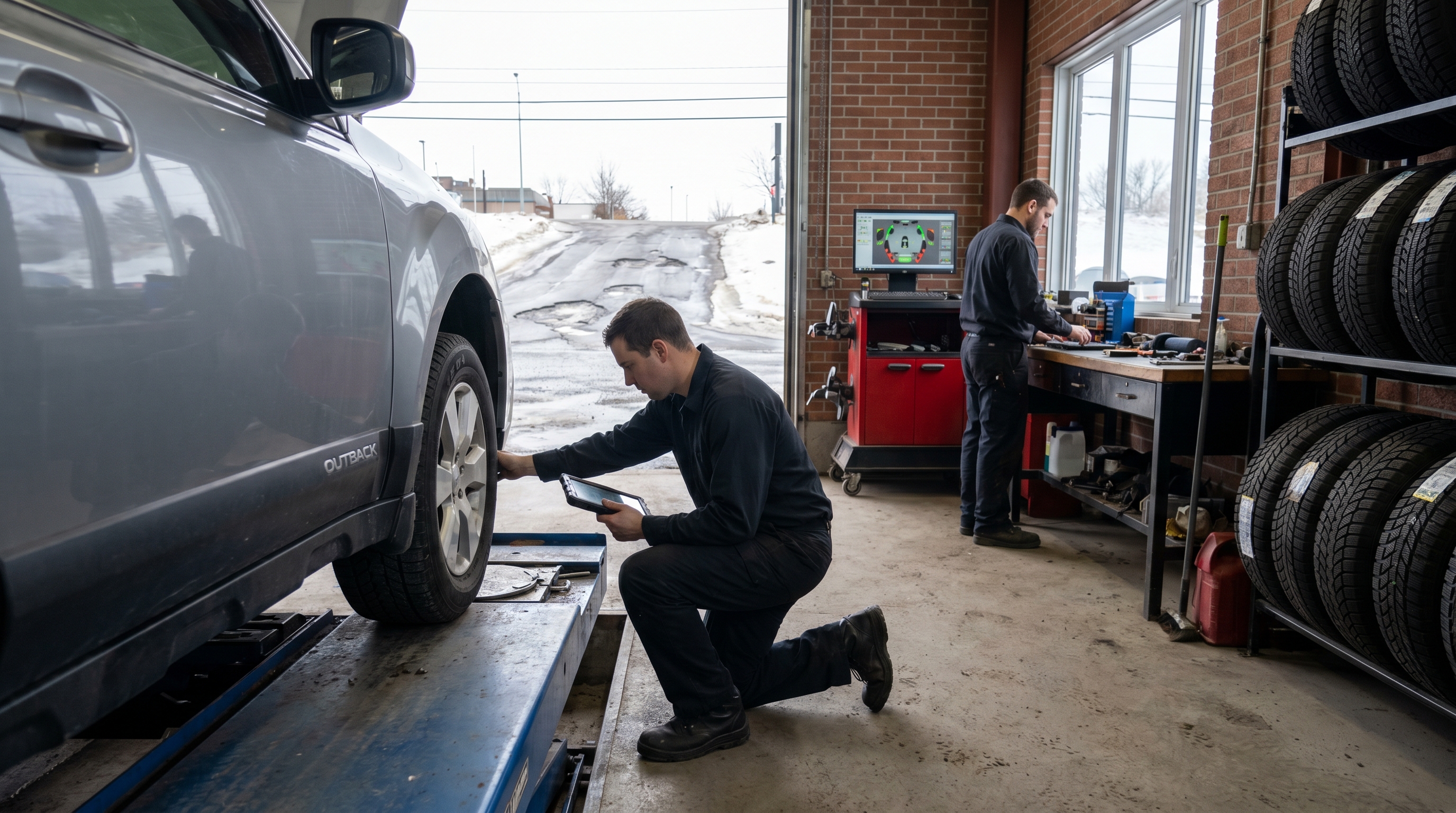
What are the symptoms of pothole damage?
After hitting a pothole, the most common damage symptoms are a vibrating steering wheel, the vehicle pulling to one side, a visible bulge on the tire sidewall, or a new clunking noise from the suspension over bumps. You should immediately stop driving if the steering wheel shakes violently above 60 km/h, the car pulls hard under braking, or you see a bubble on your tire sidewall.
Canadian springs are notoriously harsh on vehicles. Freeze-thaw cycles create deep potholes in cities like Montreal, Ottawa, and Toronto. Recognizing the early warning signs of pothole damage prevents secondary failures—like a blown tire at highway speeds or uneven brake wear.
Quick diagnostic checklist for post-pothole inspection
Use this decision rule after hitting a significant pothole to assess your next steps:
- Visual check (Do this immediately): Inspect all four tire sidewalls for bubbles or cuts. Look at the rims for visible bends or cracks.
- Steering check (At low speed, in an empty area): Does the steering wheel sit off-center when driving straight? Does the wheel jerk in your hands?
- Vibration check (Below 50 km/h vs. Highway speed): Minor vibrations at low speeds might indicate a lost wheel weight. Vibrations that get violently worse at 80+ km/h point to a bent rim or separated tire.
- Noise check (Over speed bumps): Listen for new clunks, squeaks, or rattles from the front or rear wheels.
If you check “Yes” to a tire bulge, violent high-speed vibration, or hard steering pull, pull over safely. Do not continue driving at highway speeds.
1. Tire and wheel damage symptoms
Tires and wheels take the initial brunt of a pothole impact. The symptoms here are the most visible but require careful inspection.
Sidewall bulges and tire separation
A bubble or bulge on the tire sidewall means the internal cords have snapped, allowing air to press against the outer rubber. This is not cosmetic; it is a blowout risk.
- Symptom: A visible lump on the side of the tire, often on the inward-facing side which is harder to see.
- Action: The tire must be replaced immediately. It cannot be safely patched or repaired.
Bent or cracked rims
Aluminum alloy wheels are highly susceptible to bending under sharp impacts. Steel wheels are more resilient but can still deform.
- Symptom: A rhythmic thumping sound at low speeds, or a constant vibration in the steering wheel or floorboard that increases with vehicle speed.
- Action: Minor bends can sometimes be remanufactured by a specialty wheel shop. Cracked wheels must be replaced, as welding aluminum rims is generally an unsafe practice for daily drivers.
Slow air leaks
The tire bead can break its seal against the bent rim, or the impact can cause micro-fissures in the rubber.
- Symptom: The Tire Pressure Monitoring System (TPMS) light illuminates on the dash, or you have to add air to the same tire every few days.
- Action: Have the tire dismounted to inspect the bead and rim lip. Driving on under-inflated tires will destroy the sidewall and increase stopping distances.
2. Steering and alignment symptoms
If the wheels and tires survive the impact intact, the force transfers directly into the steering linkage and chassis.
Steering wheel pulling
A hard pull to the left or right means the impact knocked the suspension components out of their factory alignment specifications.
- Symptom: The car drifts to the ditch or centre line when you momentarily let go of the steering wheel on a flat, straight road.
- Action: Book a wheel alignment. Driving with misaligned wheels will quickly destroy the inner or outer edges of your tires.
Crooked steering wheel
Even if the car tracks straight, the steering wheel itself might sit at an angle (e.g., the logo is tilted).
- Symptom: The steering wheel is off-center when driving in a straight line.
- Action: This indicates unequal toe alignment on the front or rear axle, often caused by a bent tie rod. A standard alignment check will diagnose which part yielded.
3. Suspension damage symptoms
Suspension components are designed to absorb impacts, but extreme shocks from deep potholes can bend metal and blow seals.
Clunking or rattling noises
Worn or broken suspension parts create play in the system, resulting in metallic noises.
- Symptom: A distinct clunk or knock when driving over expansion joints, railroad tracks, or speed bumps.
- Action: This often points to a bent control arm, a failed strut mount, or a broken sway bar end link. Have a mechanic put the car on a hoist to check for play in the joints.
Illustrative example: A bent front control arm
Imagine you are driving your compact car in Montreal after a late-spring freeze. The right front wheel hits a deep pothole hidden by a puddle. You hear a loud bang. At first, the car seems fine. However, over the next few days, you notice the steering wheel is slightly tilted to the right to keep the car straight. You also hear a faint clicking sound when turning into a parking spot.
This is a classic scenario where the impact bent the lower control arm. The mechanics of the failure are straightforward: the sudden upward force of the pothole exceeds the tensile strength of the stamped steel, permanently deforming the arm. This shifts the wheel’s camber and toe angles, causing the steering wheel to sit crooked and slowly destroying the tire’s edge. Because the metal is bent, it cannot be bent back safely; it requires a full replacement and a four-wheel alignment.
Failure modes: When to stop guessing and call a garage
Self-diagnosis has hard limits. There are specific failure modes where continuing to drive or guessing the problem is dangerous and expensive.
- Fluid leaks: If you see clear or amber fluid pooling behind the front wheels after a hard pothole hit, you may have ruptured a shock absorber or power steering line. Stop driving.
- Spongy or unresponsive brakes: A severe front impact can theoretically damage brake lines or knock brake pads completely out of their caliper brackets. If the brake pedal goes to the floor or the car violently pulls to one side under braking, pull over immediately and call a tow truck.
- Vibration that shakes your vision: If the steering wheel vibration is severe enough to blur your vision or make the rearview mirror shake at 60 km/h, a bent rim or severely separated tire is actively destroying itself. Do not drive it to the shop; have it towed.
- Quebec regulatory context: While the SAAQ does not conduct specific “pothole damage inspections,” your vehicle must remain roadworthy. If you submit a claim to the city for damage, an independent garage report detailing the specific parts damaged by the impact is typically required. CarZen cannot file municipal claims for you, but our network of garages can provide the necessary mechanical diagnostics.
How CarZen helps with pothole damage
CarZen is a marketplace that connects Canadian drivers with trusted local garages. If you have identified symptoms of pothole damage, or if you simply want a post-winter safety check, CarZen can help.
- Find the right service: We connect you with garages equipped for wheel alignments, tire replacements, suspension repairs, and comprehensive multi-point inspections.
- Transparent quoting: You can use the platform to get estimates for specific repairs based on your vehicle’s make and model.
- Verification: CarZen helps you find service centers, but we do not replace the physical inspection. A mechanic must test drive the vehicle and put it on a hoist to give a final, safe diagnosis.
Practical pricing assumptions for pothole repairs
Repair costs for pothole damage vary wildly depending on the damage. Below are practical estimate ranges based on Canadian market averages to help you budget. These are estimates only; actual prices depend heavily on your specific vehicle, local labor rates, and parts availability.
- Wheel alignment: $100 – $200 (Standard vs. premium suspensions)
- Tire replacement (single tire): $150 – $400+ (Economy all-seasons vs. high-performance or specialty SUV tires)
- Rim replacement (single wheel): $200 – $800+ (Basic steel wheel vs. OEM or aftermarket alloy)
- Tie rod or control arm replacement: $300 – $900+ per side (Parts and labor vary greatly by domestic vs. imported vehicles)
- Full shock/strut replacement: $600 – $1,400+ per axle (A highly labor-intensive repair)
Variables that change these estimates include whether you go to a dealership versus an independent shop, the cost of OEM versus aftermarket parts, and additional labor required if rusted bolts seize during the repair.
FAQ: Pothole damage in Canada
Can I drive on a tire with a small sidewall bulge?
No. A bulge on the sidewall means the internal structural cords of the tire have snapped. It is a high risk for a sudden blowout. The tire must be replaced immediately. Do not drive on it at highway speeds.
How do I know if my alignment is off after a pothole?
The most obvious signs are the steering wheel sitting at an angle while driving straight, or the vehicle actively pulling to the left or right when you loosen your grip on the wheel on a flat road. Uneven, rapid wear on the edges of your tires is a secondary symptom.
Does car insurance cover pothole damage in Canada?
It depends on your specific auto insurance policy. Damage from potholes is typically covered if you have comprehensive or collision coverage, but you will have to pay your deductible. Check directly with your insurance provider, as some municipalities also offer damage claim programs under strict conditions.
Why does my car clunk after hitting a pothole?
A clunking or knocking sound usually indicates physical play in a suspension component. The impact likely bent a tie rod, broke an end link, or damaged a strut. The metal-on-metal sound occurs when the loose parts shift over bumps. Have a mechanic inspect the steering and suspension immediately.
How soon should I get an alignment after hitting a pothole?
As soon as possible. If the impact was hard enough to bend a rim or knock the alignment out, driving on misaligned wheels will quickly shred your tires, turning a $150 alignment fix into an $800 tire replacement bill.
Frequently asked questions
Can I drive on a tire with a small sidewall bulge?
No. A bulge means the tire's internal structure has failed and a blowout is imminent. The tire must be replaced immediately.
How do I know if my alignment is off after a pothole?
The steering wheel will sit crooked while driving straight, or the vehicle will pull to one side. You may also notice uneven wear on the edges of your tires.
Does car insurance cover pothole damage in Canada?
It depends on your policy. Damage is typically covered under collision or comprehensive coverage, subject to your deductible. Check with your insurance provider and review local municipal claim programs.
Why does my car clunk after hitting a pothole?
A clunking noise indicates play in the suspension. The impact likely bent a tie rod, broke a sway bar link, or damaged a strut mount. Have the vehicle inspected by a garage before driving at highway speeds.
How soon should I get an alignment after hitting a pothole?
Immediately. Driving on a misaligned vehicle will rapidly destroy your tires, leading to much more expensive replacements. Get it checked at the first sign of pulling or a crooked steering wheel.