Severe Service Maintenance Schedule in Canada: What Changes Your Oil and Fluid Intervals
Understand how cold starts, short trips, towing, and road salt shift Canadian vehicles into severe-service maintenance schedules and what to ask your garage.
Quick answer
Most Canadian drivers who make frequent short trips, tow regularly, or drive on gravel and salted roads fall under severe-service maintenance schedules. That typically means changing engine oil every 5,000–6,000 km instead of the standard 10,000–15,000 km, and inspecting brakes, fluids, and filters more often.
Key facts
- Market
- CA
- Severe-service oil change interval (typical)
- 5,000–6,000 km or 6 months, whichever comes first
- Standard oil change interval (typical)
- 10,000–15,000 km or 12 months
- Primary triggers
- Frequent trips under 8 km, regular towing, unpaved roads, sustained sub-zero operation
- Date verified
- 2026-06-05
- Regulatory scope
- CA — no single federal mandate; intervals follow manufacturer specifications and provincial safety requirements
Service boundaries
- CarZen helps you find a garage and request quotes for maintenance services such as oil changes, brake repairs, fluid flushes, and seasonal tire changes.
- CarZen does not prescribe, override, or certify manufacturer-specific maintenance intervals for any particular make or model.
- Official severe-service classification and exact intervals must be confirmed using your vehicle owner manual or by a licensed garage, especially if your warranty or extended warranty depends on documented service history.
- Provincial mechanical inspection requirements (e.g., Quebec's SAAQ inspection for used vehicles or certain administrative checks) are governed by the relevant authority and must be performed by an authorized facility.
What can change the price
- Oil changes: approximately $70–$160 depending on synthetic vs. conventional oil, engine size, and garage location. Severe-service schedules may double your annual oil-change spend because intervals are roughly half as long.
- Brake inspections and repairs: typically $100–$400 per axle; severe service (mountain driving, towing, road salt) accelerates pad and rotor wear, potentially moving a replacement forward by months or thousands of kilometers.
- Fluid flushes (transmission, brake, coolant): roughly $100–$250 each, with frequency depending on whether the vehicle operates in extreme heat or cold, tows heavy loads, or sees consistent stop-and-go traffic.
- All estimates are illustrative and depend on vehicle make and model, local labor rates, parts availability, and garage pricing. They are not quotes from CarZen.
Sources and useful pages
Related CarZen services
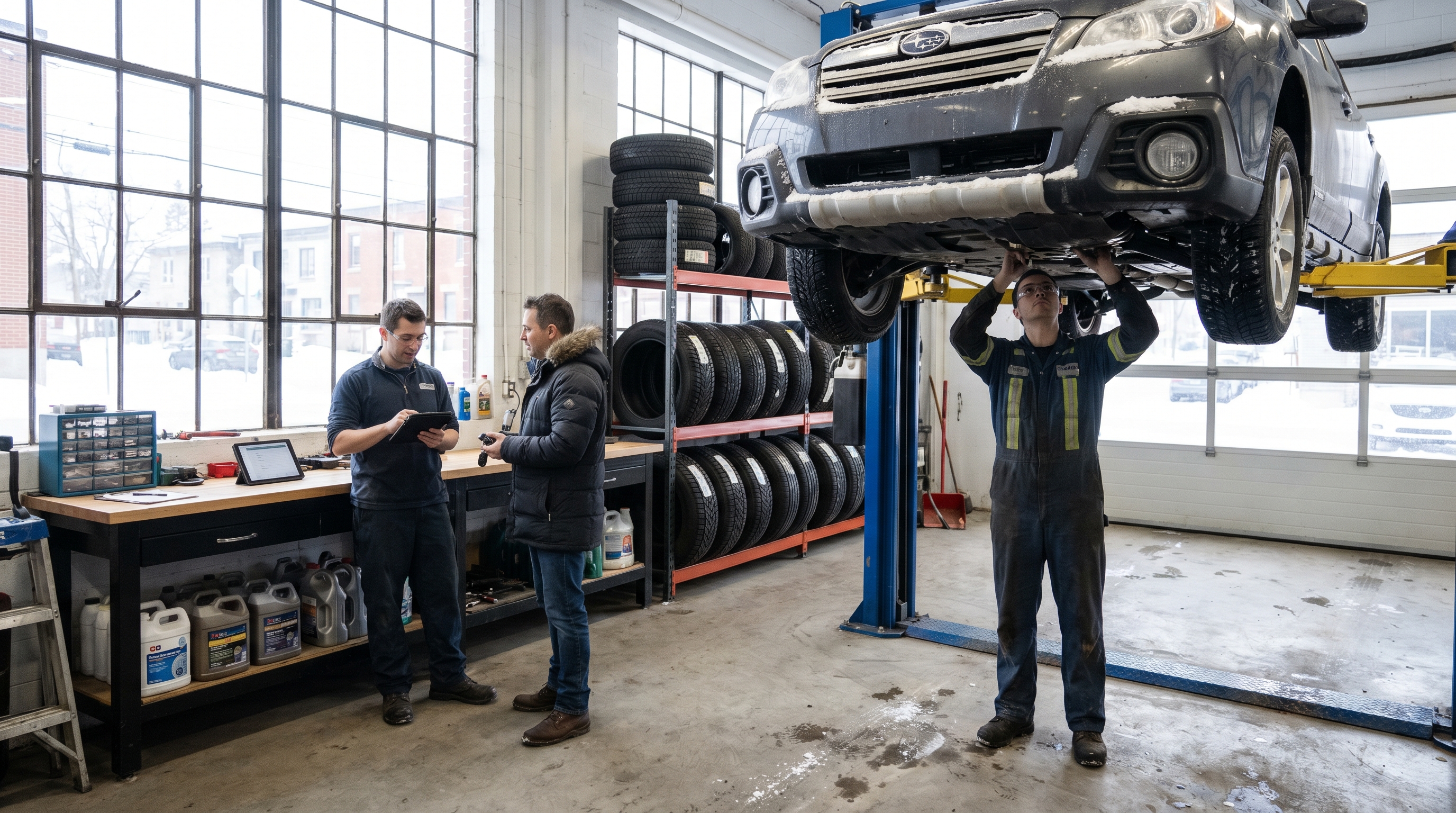
Direct answer: most Canadian drivers are in severe service
If you drive in Canada and regularly make trips shorter than 8 km, operate your vehicle in sustained sub-zero temperatures, tow a trailer or carry heavy loads, drive on gravel or unpaved roads, or navigate salted and sanded winter streets, your vehicle almost certainly qualifies for the “severe service” maintenance schedule described in your owner manual. This typically cuts recommended oil-change intervals roughly in half—from roughly 10,000–15,000 km down to 5,000–6,000 km—and accelerates wear on brakes, filters, fluids, and suspension components.
What “severe service” actually means
Severe service is a manufacturer classification, not a legal category. Most automakers define it through a list of operating conditions rather than a single threshold. Common criteria include:
- Repeated short trips where the engine does not reach full operating temperature.
- Frequent driving in stop-and-go traffic or at low speeds.
- Sustained operation in temperatures below -12 °C or above +35 °C.
- Regular towing or carrying loads near the vehicle’s rated capacity.
- Driving on rough, muddy, dusty, or salt-treated roads.
If any one of these applies consistently, the manufacturer considers the vehicle to be in severe service. It does not require all of them.
Why Canadian conditions trigger severe-service schedules
Canadian drivers face a combination of factors that align closely with severe-service definitions:
- Cold starts. Engine oil is thicker at low temperatures. On very cold mornings, it takes longer for oil to reach critical components. Frequent cold starts increase bearing and cam wear, especially when trips are too short for the engine to warm up fully.
- Short trips. Trips under 8 km prevent the engine and exhaust system from burning off condensation and unburned fuel. Over time, this dilutes engine oil and promotes internal corrosion. In Quebec and Ontario, many urban commutes fit this pattern, particularly in winter.
- Road salt and gravel. Municipal and provincial road crews apply salt, sand, and gravel for winter traction. These materials accelerate corrosion on brake lines, suspension components, and underbody structures. They also degrade rubber bushings and seals faster than clean, dry roads.
- Temperature swings. Seasonal shifts from -30 °C to +30 °C cause repeated expansion and contraction of metal and rubber parts, stressing gaskets, hoses, and seals. Fluids degrade faster under these conditions.
- Towing and loads. Whether hauling a snowmobile trailer in Saguenay or a boat in Muskoka, towing increases transmission and engine temperatures, accelerates brake wear, and puts additional stress on cooling systems and differentials.
How intervals change under severe service
Exact intervals depend on the manufacturer, but the following pattern is typical:
| Service item | Standard interval (typical) | Severe-service interval (typical) | |---|---|---| | Engine oil and filter | 10,000–15,000 km or 12 months | 5,000–6,000 km or 6 months | | Automatic transmission fluid | 80,000–100,000 km | 50,000–60,000 km | | Brake fluid | Every 3 years | Every 2 years or as tested | | Coolant | 5 years or 100,000 km | 3 years or 60,000 km | | Cabin and engine air filters | 30,000–50,000 km | 20,000–30,000 km | | Brake pad inspection | Every 20,000 km | Every 10,000–15,000 km |
These are representative ranges. Your owner manual is the authoritative source. If you no longer have the physical manual, most manufacturers offer PDF versions online.
Decision rule: are you in severe service?
Use the following practical checklist. If two or more items apply to your driving pattern over a typical month, assume severe service until a qualified garage confirms otherwise:
- More than half your trips are under 8 km in length.
- You regularly start the engine when the outside temperature is below -12 °C.
- You tow a trailer, camper, or sled at least once per month.
- You frequently drive on unpaved, gravel, or construction-zone roads.
- Your vehicle is exposed to road salt for three or more months per year.
- You operate in sustained stop-and-go urban traffic with average speeds under 30 km/h.
- You carry loads exceeding 60% of the vehicle’s rated payload or towing capacity on a regular basis.
If only one item applies—for example, you live in a mild coastal region and drive mostly on highway at steady speeds—you may be closer to standard service. A garage can confirm based on fluid analysis and inspection.
Illustrative example: Montreal commuter who tows on weekends
Consider a driver who lives in Montreal and commutes 6 km each way to a REM station, five days a week, year-round. On winter weekends, they tow a snowmobile trailer roughly 150 km round-trip. Their daily commute alone (short trips, cold starts, road salt) qualifies as severe service. The weekend towing reinforces it. This driver should follow the severe-service oil-change interval of roughly 5,000–6,000 km and inspect brakes, suspension, and transmission fluid more frequently than someone cruising at 100 km/h on dry, clean asphalt in a temperate climate.
Failure modes: where this advice breaks down
This guidance has limits. You should stop relying on generic severe-service rules and consult a licensed garage directly if:
- Your vehicle is still under a new or extended warranty that specifies documented service intervals and approved service facilities. Missing or delaying a required service could void coverage.
- The oil-life monitoring system on your dashboard indicates a remaining oil life below 15%, even if you have not reached the distance or time threshold. Modern systems account for driving patterns more precisely than fixed schedules.
- You notice unusual symptoms: engine knocking, transmission slipping, brake pulsation, or fluid leaks under the vehicle. These indicate a specific problem that a general maintenance schedule will not solve.
- You drive a hybrid or battery-electric vehicle. These vehicles have different drivetrain stresses and may not follow traditional severe-service definitions for engine oil.
- Your vehicle has a diesel particulate filter (DPF) or selective catalytic reduction (SCR) system. Short trips can clog DPFs and cause expensive failures independent of oil-change intervals.
In any of these cases, a garage with access to your vehicle’s service history and diagnostic data can make a model-specific recommendation.
What CarZen helps with
CarZen is an automotive maintenance marketplace that connects Canadian drivers with garages. For severe-service maintenance, CarZen can help you:
- Find and compare garages in your area for oil changes, brake inspections, fluid services, and seasonal maintenance.
- Request quotes so you can see estimated costs before booking.
- Access informational blog content—like this article—to help you interpret your owner manual and understand what to ask a mechanic.
CarZen does not diagnose vehicle problems, prescribe maintenance intervals for specific models, or perform mechanical inspections. Those tasks require a licensed garage or dealership with direct access to your vehicle. If you are unsure whether your driving pattern qualifies as severe service, ask a mechanic to review your owner manual alongside your actual conditions.
Frequently asked questions
Is severe service only a winter issue in Canada?
No. While winter amplifies cold-start and road-salt effects, severe-service schedules also apply in summer if you tow frequently, drive on dusty gravel roads, or operate in sustained stop-and-go traffic at high ambient temperatures. Severe service is determined by operating conditions, not calendar season.
Do I really need to change my oil twice as often?
In many Canadian driving patterns, yes. If your owner manual defines your conditions as severe service and specifies a 5,000–6,000 km interval, following the longer standard interval risks increased engine wear, oil contamination from condensation and unburned fuel, and potential sludge buildup. The cost of more frequent oil changes is typically far lower than the cost of premature engine repairs.
What if my car has an oil-life monitoring system?
Oil-life monitors are generally reliable and account for driving patterns better than fixed mileage intervals. If your system shows remaining oil life above 50% at the severe-service distance threshold, you can usually trust it. However, in very cold climates or with extensive short-trip driving, some systems may overestimate remaining life. A garage can pull a used oil sample for analysis if you want confirmation.
Does severe service affect lease vehicles?
Yes. Lease return inspections assess overall condition, including mechanical wear. Following the correct maintenance schedule—whether standard or severe service—helps avoid excess-wear charges. Keep service records, especially if you lease in provinces with mandatory mechanical inspections.
Where can I confirm the correct schedule for my vehicle?
Your owner manual is the primary source. Most manufacturers provide a severe-service section with a specific table. If you do not have the manual, search your make, model, and year online along with “maintenance schedule PDF.” You can also ask a licensed garage to confirm during your next service appointment.
Frequently asked questions
Is severe service only a winter issue in Canada?
No. While winter amplifies cold-start and road-salt effects, severe-service schedules also apply in summer if you tow frequently, drive on dusty gravel roads, or operate in sustained stop-and-go traffic at high ambient temperatures. Severe service is determined by operating conditions, not calendar season.
Do I really need to change my oil twice as often?
In many Canadian driving patterns, yes. If your owner manual defines your conditions as severe service and specifies a 5,000–6,000 km interval, following the longer standard interval risks increased engine wear, oil contamination from condensation and unburned fuel, and potential sludge buildup. The cost of more frequent oil changes is typically far lower than the cost of premature engine repairs.
What if my car has an oil-life monitoring system?
Oil-life monitors are generally reliable and account for driving patterns better than fixed mileage intervals. If your system shows remaining oil life above 50% at the severe-service distance threshold, you can usually trust it. However, in very cold climates or with extensive short-trip driving, some systems may overestimate remaining life. A garage can pull a used oil sample for analysis if you want confirmation.
Does severe service affect lease vehicles?
Yes. Lease return inspections assess overall condition, including mechanical wear. Following the correct maintenance schedule—whether standard or severe service—helps avoid excess-wear charges. Keep service records, especially if you lease in provinces with mandatory mechanical inspections.
Where can I confirm the correct schedule for my vehicle?
Your owner manual is the primary source. Most manufacturers provide a severe-service section with a specific table. If you do not have the manual, search your make, model, and year online along with "maintenance schedule PDF." You can also ask a licensed garage to confirm during your next service appointment.