Why Tire Pressure Drops in Cold Weather in Canada: How to Check, Adjust, and Know When It’s a Leak
Learn why tire pressure drops in Canadian cold weather, how to check pressure when tires are cold, and when to ask a garage to inspect for a slow leak.
Quick answer
Tire pressure drops in cold weather because air contracts as temperatures fall—roughly 1 to 2 psi for every 5°C drop in Canada. Check pressure when tires are cold using a gauge, top up to the placard limit, and recheck. If pressure keeps falling after a top-up, ask a garage to inspect for a leak.
Key facts
- Market
- CA
- Pressure drop rate
- ~1–2 psi per 5°C temperature drop
- Ideal timing
- Check tires cold, before driving or after 3+ hours parked
- Source of target psi
- Vehicle placard (driver’s door jamb), not tire sidewall
- Regulatory scope
- Canada-wide; winter tire rules vary by province (e.g., QC mandate Dec 1–Mar 15)
Service boundaries
- CarZen connects drivers with partner garages for seasonal tire changeovers, pressure checks as part of broader services, and inspections.
- CarZen does not provide real-time pressure readings, regulatory enforcement, or roadside inflation. A physical gauge or garage visit is required for accurate measurements and leak diagnosis.
What can change the price
- Air top-ups at self-serve stations are often free or low cost (loose change).
- Nitrogen inflation, if offered, may range from roughly $20–$60 for four tires, depending on the shop and region.
- A dedicated tire leak diagnosis at a garage can vary widely, generally starting around $40–$100+, influenced by local labour rates, shop type, and whether a repair is ultimately needed.
Sources and useful pages
Related CarZen services
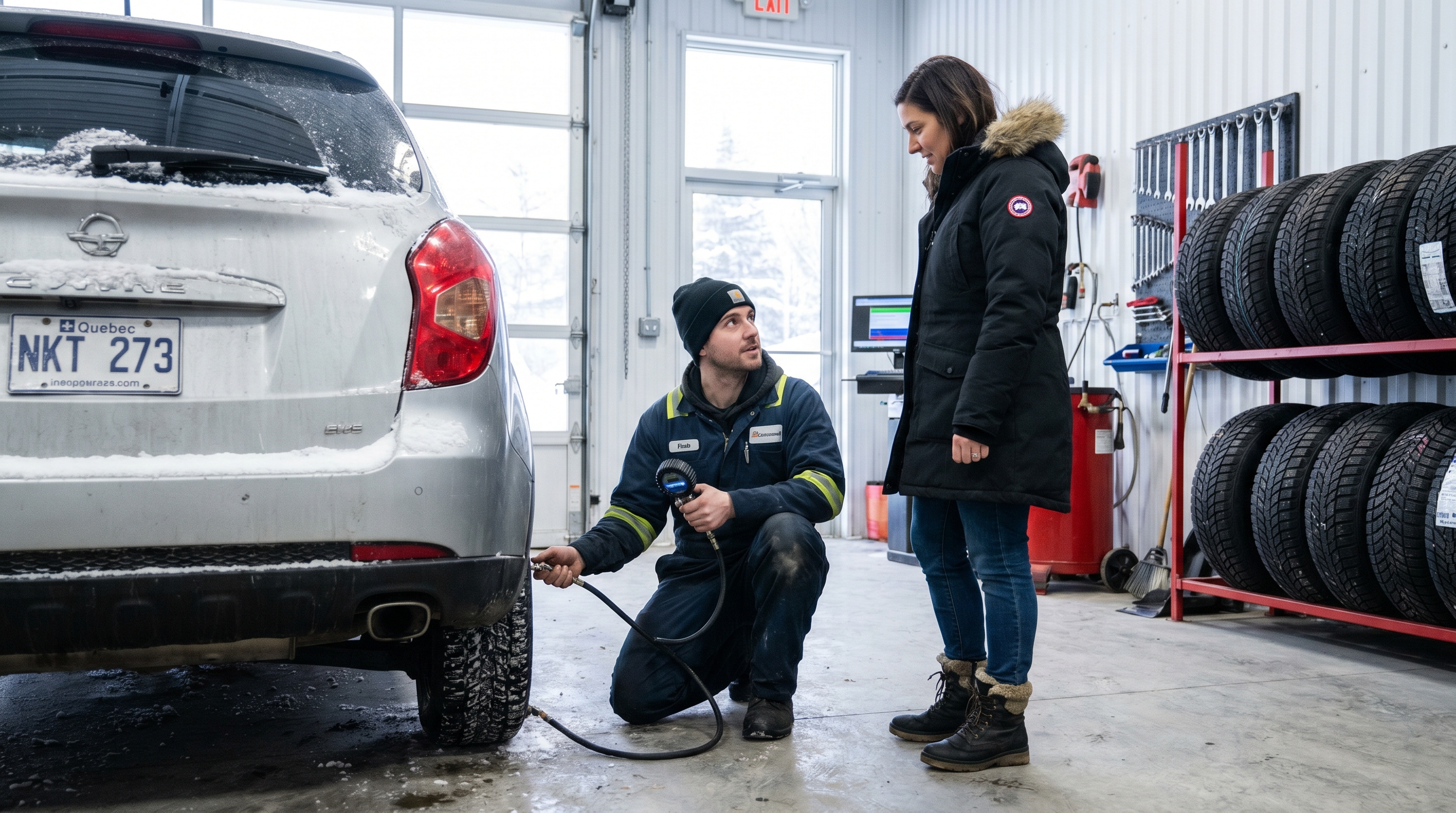
Why Tire Pressure Drops in Canadian Cold Weather
Tire pressure drops in cold weather because the air inside your tires contracts as the temperature falls. In Canada, where autumn temperatures can swing from 10°C to -20°C in weeks, this contraction causes a loss of roughly 1 to 2 psi for every 5°C drop. This is basic physics—Charles’s Law—not necessarily a puncture. If your tire pressure monitoring system (TPMS) light turns on during the first deep freeze, the most likely cause is cold air, not a nail. Check your pressure with a gauge when the tires are cold, inflate them to the vehicle manufacturer’s recommended psi found on the driver’s door placard, and monitor for changes.
How Temperature Affects Tire Pressure
Air expands when heated and contracts when cooled. Inside a sealed tire, this means the internal pressure changes in direct response to ambient temperature.
- Rough benchmark: Expect approximately a 1–2 psi drop for every 5°C decrease in ambient temperature.
- Canadian winter reality: If you set your tires to 35 psi at 15°C in October, a cold snap dropping to -15°C can reduce pressure by 6 to 12 psi, leaving your tires visibly underinflated.
- Heat from driving: Road friction and flexing increase tire temperature. Pressure readings taken immediately after driving will be artificially high and unreliable for adjustment.
Illustrative example:
You inflate your tires to 34 psi in a heated 20°C garage in November. You park the car outside overnight in January, and the temperature drops to -25°C. A 45°C temperature drop can theoretically reduce the pressure by 9 to 18 psi. Your tires could read between 16 and 25 psi in the morning, which is severely underinflated and potentially dangerous to drive on.
How to Check Tire Pressure Correctly
Checking tire pressure seems straightforward, but doing it incorrectly leads to chronic underinflation or overinflation.
Finding your target pressure
- Open the driver’s side door.
- Look for a placard or sticker on the B-pillar or the door frame.
- Read the recommended cold tire pressure (e.g., “32 psi”).
- Ignore the maximum pressure molded into the tire sidewall—this is a physical limit for the tire, not a recommendation for your specific vehicle.
Checking when tires are cold
- “Cold” means the vehicle has been parked for at least three hours or driven for less than 2 km at low speeds.
- Do not check pressure in a heated garage if the car will be driven in sub-zero temperatures. The reading will be inaccurate for actual driving conditions. Move the car outside for a few hours before checking during extreme cold snaps.
Step-by-step procedure
- Remove the valve cap. Keep it safe; losing it exposes the valve to moisture and road salt.
- Press a calibrated tire gauge firmly onto the valve stem. A hissing sound means air is escaping—press harder or adjust the angle.
- Read the gauge. Compare it to the door placard pressure.
- Inflate if low. Use a trusted air pump, such as those at a gas station or your own compressor. Add air in short bursts, checking between each.
- Re-check the pressure. Ensure it matches the cold placard value.
- Replace the valve cap.
- Repeat for all four tires. Do not forget the spare if it is accessible.
Decision rule for seasonal pressure management
Use this checklist to maintain safe pressure throughout the Canadian winter:
- [ ] Check pressure monthly from November through March.
- [ ] Check pressure before long highway drives.
- [ ] Always check when tires are cold (parked 3+ hours).
- [ ] Inflate to the door placard psi, not the sidewall max.
- [ ] If the ambient temperature drops significantly (e.g., a sudden cold snap), recheck the next morning.
- [ ] If you top up and the light returns within a few days, proceed to leak inspection.
Cold Weather vs. Slow Leaks
Not every pressure loss is from the cold. Deciding whether you have a leak requires tracking the pressure over a short period.
When it is likely just the cold
- The TPMS light appears the morning of the season’s first hard frost.
- All four tires drop by a similar amount.
- Pressure stabilizes after you top up to the placard psi.
When to suspect a leak
- One specific tire drops significantly faster than the others.
- You have topped up a tire more than twice in two weeks.
- The tire is visibly flattened or the sidewall is bulging.
- You can hear a faint hissing sound near the tread or valve.
Where This Advice Breaks: Failure Modes and Edge Cases
This general guidance stops being reliable under certain conditions. Do not rely on a simple top-up if you encounter the following:
- Sidewall damage: A bulge, crack, or deep scuff on the sidewall compromises the tire’s structural integrity. This requires immediate professional inspection, not a pressure adjustment.
- TPMS sensor failure: If the warning light blinks for 60–90 seconds upon startup, then stays solid, this often indicates a malfunctioning sensor or dead battery in the sensor, not low tire pressure.
- Frozen valves: In extreme cold, moisture inside the valve stem can freeze, preventing accurate readings or causing a continuous leak when you try to check pressure.
- Bead seal leaks: In older tires or those with corroded wheels, cold temperatures can cause the seal between the tire bead and the wheel rim to contract, creating a slow leak that won’t be fixed by a simple top-up.
If you experience any of these, or if your tire is repeatedly flat in the morning despite being inflated the night before, stop guessing and book a garage inspection. Driving on severely underinflated tires damages the sidewall, increases stopping distance, and risks a blowout.
How CarZen Helps Canadian Drivers with Tire Maintenance
CarZen is an automotive maintenance marketplace. We help Canadian drivers and garage owners connect for seasonal services.
- Booking support: You can use CarZen to find and book with partner garages for winter tire changeovers, seasonal inspections, and general maintenance.
- Information: Our blog provides guidance on when to seek professional services.
- Boundaries: CarZen does not perform physical inspections, inflate tires, or diagnose leaks. We are not a substitute for a certified mechanic or a physical tire gauge. Any estimates or ranges mentioned are practical guidelines, not quotes or guarantees.
For hands-on help, use CarZen to locate a trusted local garage for a professional inspection and top-up as part of your winter maintenance routine.
Frequently asked questions
How much does tire pressure drop in cold weather in Canada?
Tire pressure generally drops by about 1 to 2 psi for every 5°C decrease in temperature. During severe cold snaps, it is normal for tires to lose 4 to 8 psi overnight.
Should I inflate my tires to the pressure listed on the tire sidewall?
No. The number on the sidewall is the tire's maximum safe pressure. You should inflate your tires to the pressure listed on the vehicle placard, usually found on the driver's side door jamb.
Is it normal for the tire pressure light to come on when it gets cold?
Yes. A TPMS light triggered by a sudden temperature drop is normal and often indicates that the air inside your tires has contracted. Check the pressure with a gauge and inflate to the recommended cold placard psi if necessary.
When should I stop inflating the tire myself and call a garage?
You should seek professional help if a single tire repeatedly loses pressure, if the tire has visible damage like a bulge or nail, or if you hear a hissing sound. These symptoms point to a physical leak or damage that requires a garage diagnosis.
How do I check tire pressure when it is very cold outside?
Ensure the car has been parked outside for at least three hours so the tires match the outdoor temperature. Use a reliable digital or dial gauge, as inexpensive pen-type gauges can sometimes stick in extreme cold. Remove the valve cap quickly, check the pressure, and replace the cap immediately to prevent moisture from freezing the valve.