Winter Tire Tread Depth in Canada: Why 4 mm Matters and When to Replace
Learn why 4 mm is the practical winter tire tread depth threshold for Canadian driving, how to measure it accurately, and when to book a replacement before s...
Quick answer
In Canada, replace winter tires when tread depth reaches 4 mm. While 1.6 mm is the legal minimum, 4 mm is the practical threshold where snow traction and stopping distance significantly degrade. Measure using a tread depth gauge in multiple locations. Replace tires before the winter season for optimal safety on snow-covered roads.
Key facts
- Legal minimum tread depth in most Canadian provinces
- 1.6 mm (2/32 inch)
- Recommended winter tire replacement threshold
- 4 mm (5/32 inch)
- New winter tire typical tread depth
- 10–12 mm (11/32–13/32 inch)
- Number of measurement points per tire
- At least 3 locations across the tread width
Service boundaries
- CarZen helps drivers connect with verified garages for winter tire installation, seasonal changeovers, and tire inspections. Tread depth measurements provided in CarZen content are educational estimates; a physical inspection by a qualified technician is required to confirm tire serviceability. CarZen does not perform regulatory inspections, and all legal compliance questions should be directed to the SAAQ or your provincial transport authority.
What can change the price
- Winter tire replacement cost in Canada typically ranges from $400–$1,000+ for a full set, depending on vehicle size, tire brand, and performance category. Installation, balancing, and disposal fees usually add $80–$200. Prices fluctuate based on rim size (16-inch vs. 20-inch), tire type (studdable, studless ice, performance winter), and regional availability. These are practical estimates, not quotes—actual pricing must come from a garage quote.
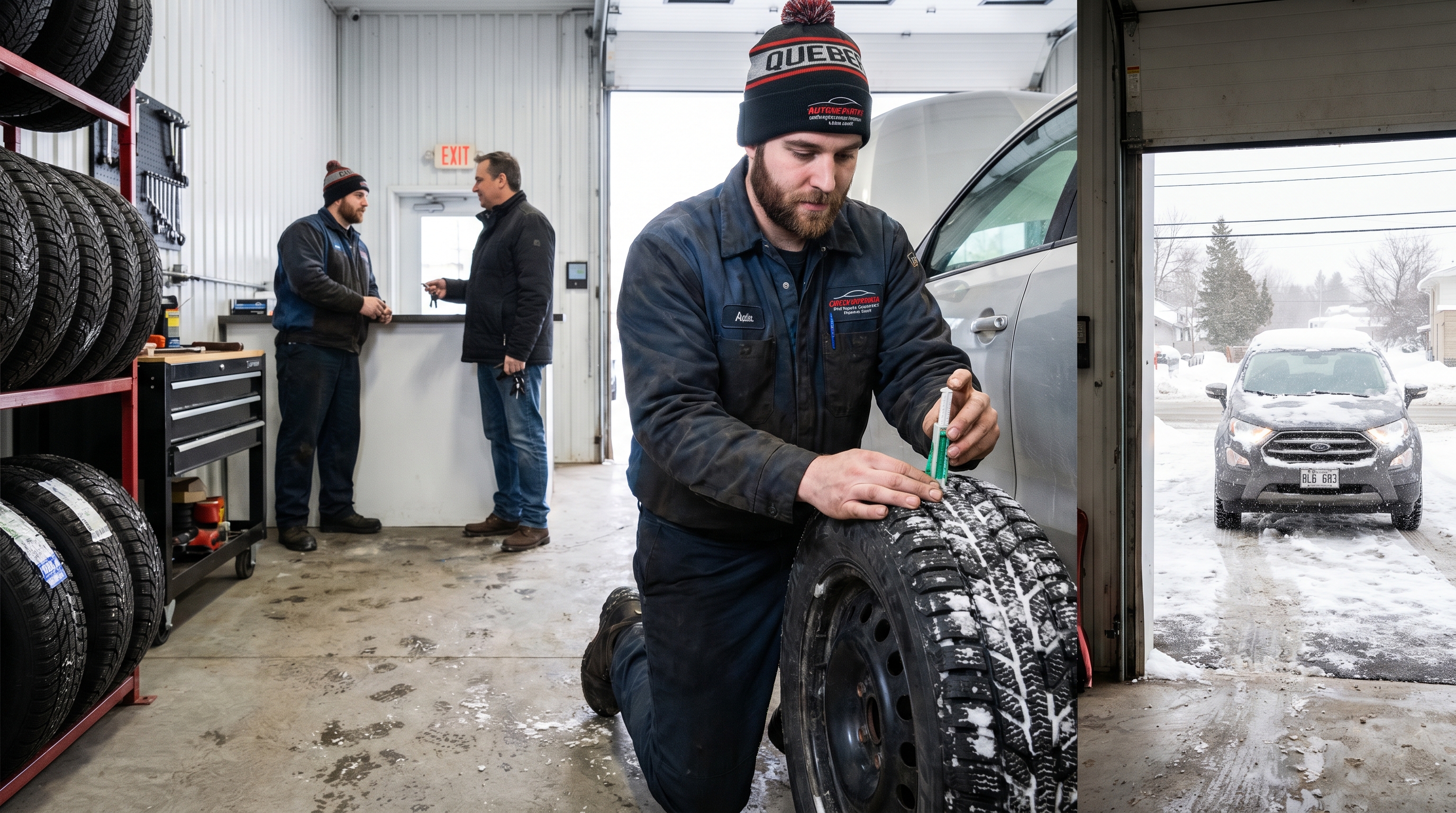
The Direct Answer: Replace Winter Tires at 4 mm Tread Depth
For Canadian drivers facing snow-covered and icy roads, 4 mm (approximately 5/32 inch) is the practical minimum tread depth for winter tires. While most provinces set the legal minimum at 1.6 mm, that threshold was designed for all-season tires on bare pavement—not for deep snow traction. Once winter tire tread wears to 4 mm, snow packing capability, ice grip, and wet stopping distance all degrade noticeably.
Measure your tread depth with a gauge in at least three points across the tire face—outer tread, centre, and inner tread. If any location reads 4 mm or less, plan replacement before the next winter season. New winter tires typically ship with 10–12 mm of tread.
Why 4 mm Matters Specifically for Snow-Covered Roads
Snow Packing and the Sipe Edge Effect
Winter tires generate snow-on-snow traction through tread voids that pack and hold snow. The packed snow in the tread grooves grips the snow on the road surface better than bare rubber does. This mechanism depends on adequate groove depth. Below 4 mm, the tread blocks cannot retain enough snow to maintain this effect.
Sipes—those thin slits cut into the tread blocks—create hundreds of biting edges for ice and hardpack grip. As the tire wears, sipes disappear first because they’re only cut to a certain depth. A winter tire at 4 mm has lost a substantial portion of its sipe density.
Stopping Distance Degradation
Published testing consistently shows that winter tire braking performance on snow and ice degrades non-linearly as tread wears. The difference between 5 mm and 4 mm is small. The difference between 4 mm and 3 mm is significant. Below 3 mm, a winter tire performs closer to a worn all-season tire than to a fresh winter tire.
On packed snow at 40 km/h, a vehicle with worn winter tires at 2 mm may require 5–10 metres more stopping distance compared to tires at 6 mm. That distance can be the difference between a safe stop and a collision at an intersection.
Hydroplaning and Slush Planing Risk
Deep tread voids channel water and slush away from the contact patch. At 4 mm and below, the tire’s ability to evacuate slush diminishes. In Quebec’s frequent freeze-thaw cycles, slush planing is a real hazard during shoulder seasons.
How to Measure Winter Tire Tread Depth Accurately
Tools You Need
- Tread depth gauge: Available at any auto parts store for $5–$15. This is the most accurate consumer tool.
- Quarter test (Canadian): Insert a 25-cent coin into the tread groove with the caribou facing down. If the tread reaches the caribou’s snout, you’re at roughly 4–5 mm. This is a rough check, not a precision measurement.
- Tread wear indicators: Most tires have small raised bars moulded into the grooves. When the tread is flush with these bars, the tire is at approximately 1.6 mm—the legal limit, not the winter-safe limit.
Measurement Protocol
- Measure in at least three locations per tire: outer groove, centre tread, and inner groove.
- Take measurements at two different points around the circumference of each tire (six total measurements per tire).
- Record the lowest reading. A tire is only as good as its most worn spot.
- Check all four tires. Uneven wear may indicate alignment or inflation issues.
Illustrative Example: Reading Uneven Wear
Illustrative example: A driver in Quebec City checks their winter tires in late October. The left front tire reads 6 mm on the outer groove, 5 mm in the centre, and 3 mm on the inner edge. The lowest reading is 3 mm—below the 4 mm threshold. This tire needs replacement. The inner edge wear pattern also suggests the vehicle may need an alignment check, which a garage can diagnose on a lift.
Decision Rule: When to Replace Winter Tires
Use this checklist before each winter season:
| Tread Depth Reading | Action | |---|---| | 6 mm or more | Tire has adequate tread for winter. Continue use. | | 5 mm | Monitor. One more season is likely fine if no other damage exists. | | 4 mm | Replace before winter. Traction on snow is meaningfully reduced. | | 3 mm or less | Replace immediately. Tire is unsafe for winter conditions. | | 1.6 mm or less | Illegal in most provinces. Do not drive on these tires. |
Additional Replacement Triggers
Regardless of tread depth, replace winter tires if:
- The tire is 10 years old or older from the manufacture date (DOT code on sidewall).
- You see visible cracking in the sidewall or tread (dry rot).
- There is a bulge or bubble on the sidewall (indicates internal damage).
- A puncture is larger than 6 mm or is in the sidewall.
- The tire has been driven on while flat or severely underinflated.
Timing: Buy Before Winter, Not During
Plan tire purchases for September or October, not December. Demand surges in late November through January, and inventory for popular sizes can run low. Booking installation early also avoids the rush at garages.
In Quebec, winter tires are mandatory from December 1 to March 15. Inspecting tires in October gives you time to order and install replacements before the deadline without paying premium rush pricing.
Tradeoffs: Cost vs. Safety Margin
Replacing at 4 mm vs. Wearing to 2 mm
A driver who replaces tires at 4 mm instead of wearing them to 2 mm loses approximately one season of marginal use. The cost tradeoff is roughly one extra set of tires over 8–10 years of driving. The safety benefit is consistent snow and ice traction every winter rather than degraded performance in the final season.
Partial Replacement vs. Full Set
If only two tires are worn below 4 mm and the other two are at 6 mm or more, you can replace just the pair. However, the new tires should always go on the rear axle, regardless of front/rear/all-wheel drive. This maintains vehicle stability and reduces oversteer risk. If the wear difference exceeds 3 mm between axles, consider replacing all four for balanced handling.
Where This Advice Breaks: Failure Modes and Exceptions
When Tread Depth Alone Doesn’t Tell the Full Story
- Rubber compound aging: Winter tire rubber is formulated to stay soft below 7°C. As the tire ages, the compound hardens even if tread depth remains adequate. A 7-year-old winter tire with 5 mm of tread may provide less ice grip than a 2-year-old tire at 4 mm.
- Temperature-specific testing limits: Most consumer tread depth guidance is based on snow performance. On pure ice at -30°C, even fresh winter tires have limited grip. Tread depth does not compensate for extreme ice conditions—studs or chains may be necessary.
- Vehicle-specific factors: Heavier vehicles (SUVs, trucks) wear tires faster and place higher loads on tread. A tread depth that is marginal on a compact car may be inadequate on a 2,500 kg SUV.
- All-wheel drive false confidence: AWD helps you accelerate in snow but does nothing for braking or cornering. Four worn winter tires on an AWD vehicle are still four worn tires.
Stop Guessing and Call a Garage If:
- You notice uneven wear across the tread face (inner edge vs. outer edge difference of 2 mm or more).
- The vehicle pulls to one side or vibrates at highway speed.
- You see cracking, bulging, or exposed cords on any tire.
- You are unsure whether a puncture is repairable.
- The vehicle has been in a collision or hit a large pothole at speed.
These symptoms require a garage to inspect on a lift, check alignment, and assess tire integrity from the inside.
What CarZen Helps With
CarZen connects Canadian drivers with verified garages for:
- Winter tire installation and seasonal changeover services across Quebec and other provinces.
- Tire inspection and tread depth assessment as part of seasonal maintenance bookings.
- Mobile mechanic services for drivers who cannot visit a garage during business hours.
CarZen’s platform provides educational content about tread depth thresholds, provincial regulations, and tire maintenance timelines. However, CarZen does not perform physical tire inspections or regulatory compliance checks. Tread depth readings done at home with a gauge are informational. A qualified technician must confirm tire serviceability, especially when safety-critical decisions are involved.
For drivers who want to book a winter tire changeover or inspection, CarZen’s service directory connects you with garages that handle seasonal tire work.
Quebec-Specific Note
Quebec law requires winter tires from December 1 to March 15. The regulation applies to all passenger vehicles and taxis registered in Quebec. The SAAQ enforces this requirement and fines apply for non-compliance. While the law mandates winter tire use, it does not specify a minimum tread depth beyond the general 1.6 mm standard. The 4 mm recommendation in this article is a practical safety threshold, not a legal requirement.
For the most current regulatory details, consult the SAAQ winter tire page directly.
Provincial Variations Across Canada
Winter tire requirements vary by province:
- Quebec: Mandatory December 1–March 15.
- British Columbia: Mandatory on designated mountain passes and highways from October 1–March 31.
- Other provinces: No legal mandate, but winter tires are strongly recommended by provincial transport agencies.
Regardless of legal requirements, the 4 mm tread depth recommendation applies anywhere Canadian drivers encounter snow-covered or icy roads.
Preparing for Next Winter: A Practical Checklist
- Inspect in October: Check all four tires with a tread depth gauge.
- Record readings: Note the lowest measurement per tire.
- Check sidewalls: Look for cracks, bulges, or damage.
- Verify tire age: Read the DOT code. If older than 10 years, replace regardless of tread.
- Book early: Schedule installation or changeover before November to avoid peak pricing and wait times.
- Store properly: If using seasonal tire swaps, store off-season tires in a cool, dry location away from sunlight and heat sources.
Frequently asked questions
Is 4 mm the legal minimum for winter tires in Canada?
No. The legal minimum in most provinces is 1.6 mm. The 4 mm threshold is a practical safety recommendation for snow and ice traction, not a legal requirement. Quebec mandates winter tire use from December 1 to March 15 but does not specify a tread depth above the general minimum.
Can I use the quarter test to check for 4 mm tread depth?
The quarter test gives a rough estimate. Insert a Canadian 25-cent coin into the groove with the caribou facing down. If the tread reaches the caribou's snout, you're at approximately 4–5 mm. For accuracy, use a tread depth gauge, which costs under $15 at any auto parts store.
Should I replace all four winter tires if only two are worn to 4 mm?
Not necessarily. If two tires are above 6 mm and only two have reached 4 mm, you can replace the worn pair. Always install the newer tires with deeper tread on the rear axle for stability. If the tread difference between axles exceeds 3 mm, replacing all four provides better balanced handling.
How fast do winter tires wear in Canadian conditions?
Winter tires typically last 4–6 seasons for average Canadian drivers covering 15,000–20,000 km per year. Wear rate depends on driving habits, road conditions, tire inflation, vehicle weight, and whether the tires are used only in winter or year-round. Using winter tires in summer dramatically accelerates wear due to soft compound degradation on warm pavement.
Do studded winter tires have different tread depth recommendations?
Studded tires follow the same 4 mm recommendation for tread depth. Additionally, studs wear down and lose effectiveness over time. Some provinces restrict studded tire use to certain months or prohibit them entirely. Check your provincial regulations before installing studded tires.