Winter Windshield Washer Fluid in Canada: Temperature Ratings, Frozen Lines, and Nozzle Checks
Learn how to pick the right winter windshield washer fluid in Canada by temperature rating, prevent frozen lines, and check wipers and nozzles before winter...
Quick answer
Use winter windshield washer fluid rated for at least -40°C in Canada. Do not dilute it with water. If your reservoir is half full of summer fluid, drain or siphon it before adding -40°C fluid, because mixing reduces its freezing protection and can crack lines or the pump.
Key facts
- Market
- CA
- Minimum recommended freeze rating for Canadian winter washer fluid
- -40°C
- Typical washer fluid reservoir capacity
- 3 to 6 litres, depending on vehicle
- Key added ingredient in winter washer fluid
- Methanol or other alcohol-based antifreeze
- Practical price range for jug of winter washer fluid
- $4 to $12 CAD per 3.8L or 4L jug at Canadian retailers, before tax
Service boundaries
- CarZen can help you find and book a Quebec garage for seasonal winter checks, including inspection of your wiper system, washer pump, and lines.
- CarZen does not sell washer fluid or verify the specific freeze rating printed on a jug; always read the product label at the store.
- If your washer lines are already frozen or cracked, or the pump makes a buzzing sound with no fluid reaching the windshield, a garage diagnosis is required before further use.
What can change the price
- A 3.8L or 4L jug of winter washer fluid typically costs between $4 and $12 CAD at Canadian auto parts stores, big-box retailers, or gas stations. Price depends heavily on brand, specific freeze rating (-40°C vs. extreme conditions), retailer, and seasonal demand spikes during deep cold snaps.
- Garage labour to thaw frozen lines, replace a cracked reservoir, or replace a failed washer pump will vary based on vehicle make and model, parts availability, and shop hourly rate. This typically ranges from a quick diagnostic fee to several hundred dollars in parts and labour for pump replacement.
Sources and useful pages
Related CarZen services
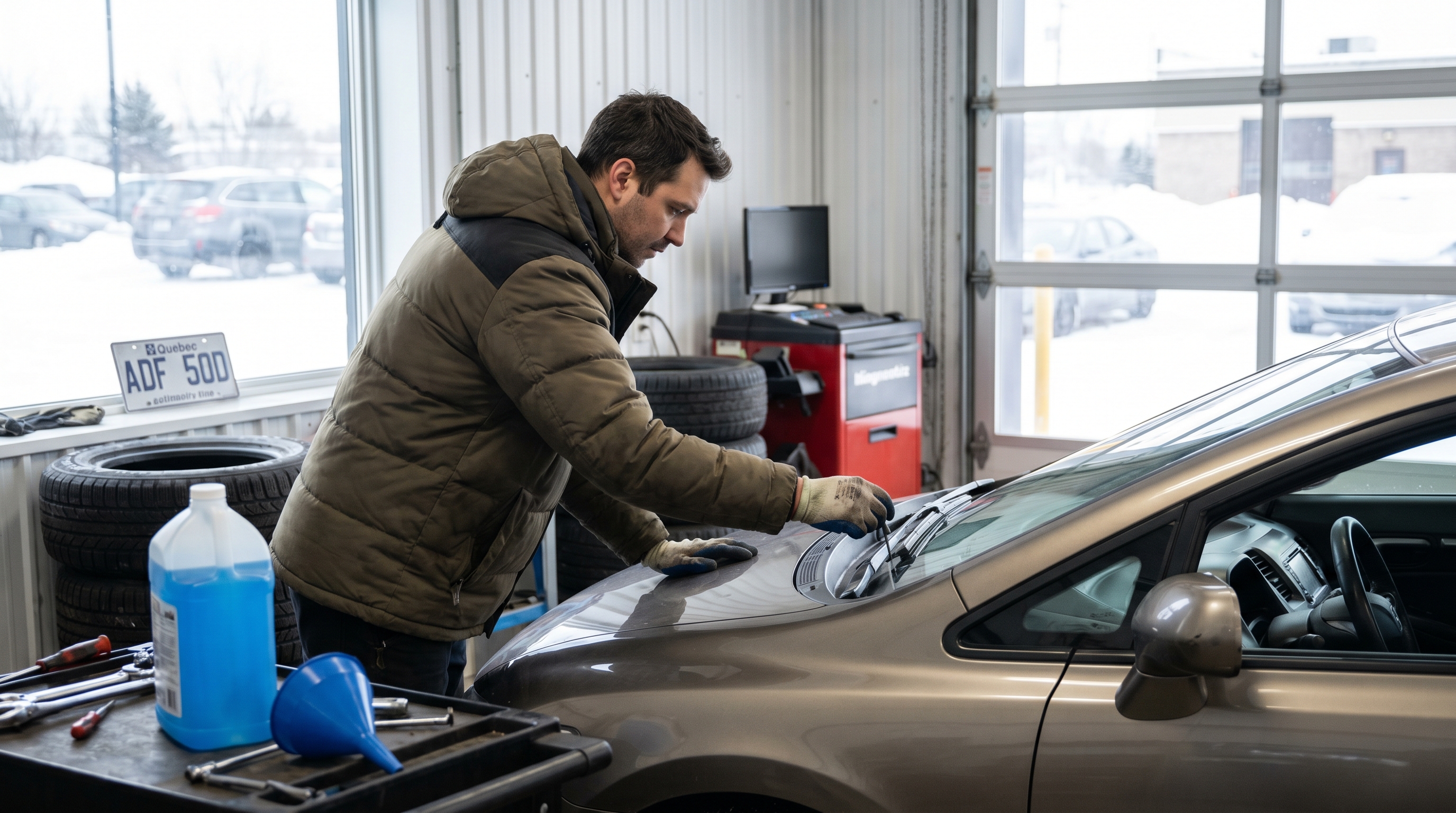
The Direct Answer: Choosing Winter Washer Fluid in Canada
Use a winter windshield washer fluid rated for at least -40°C anywhere in Canada. Do not dilute it with water. If your reservoir currently contains summer or all-season fluid, drain or siphon the old fluid out before filling it with the winter formulation. Mixing summer and winter fluid raises the effective freezing point, which can cause the mixture to freeze in the lines, block nozzles, or damage the washer pump.
In Quebec, where drivers frequently encounter heavy road salt, freezing rain, and slush, using the correct winter fluid (often referred to in French as liquide lave-glace d’hiver au Canada) is not just a matter of convenience—it is critical for safe forward visibility. While Quebec law mandates winter tires from December 1 to March 15, washer fluid specification is not legally codified in the same way, but operating with obstructed visibility is a highway safety risk.
Understanding Temperature Ratings
The freeze point printed on the jug is your primary decision metric. Canadian winter washer fluids typically display a specific temperature rating rather than relying on the word “winter” alone.
-20°C vs -40°C vs -49°C
- -20°C fluid: Inadequate for most of Canada from November through March. It may suffice for brief coastal visits in British Columbia but will freeze in the rest of the country.
- -40°C fluid: The standard baseline for Canadian drivers. It handles severe cold safely and is widely available at Canadian Tire, Walmart, gas bars, and auto parts stores.
- -49°C or lower: Formulated for extreme northern conditions or predictable deep-freeze zones in the Prairies, northern Ontario, Quebec, and the Territories. If you regularly drive in -35°C ambient temperatures, a -49°C fluid provides a safety buffer.
The rating is achieved using methanol or similar alcohol-based antifreeze additives, which lower the freezing point of the water-detergent mixture. These additives also help melt light frost on the glass on contact.
The Mixing Problem: Why Residual Summer Fluid Matters
A common failure mode occurs in October or November when a driver tops up a half-full reservoir of summer fluid with -40°C winter fluid.
Illustrative example: A driver in Montreal has two litres of leftover -5°C “bug wash” in their reservoir. They add two litres of -40°C winter fluid. The resulting mixture does not have a -40°C freeze point. The effective freeze point averages out somewhere around -20°C to -25°C, depending on the specific chemistry. When ambient temperatures drop to -30°C in January, the mixed fluid freezes solid in the lines, cracking a plastic T-fitting under the hood.
To prevent this:
- Use the windshield washers until the reservoir is nearly empty.
- If necessary, siphon or drain the remaining summer fluid.
- Fill the empty reservoir with undiluted winter fluid.
- Run the washers for several seconds to cycle the winter fluid through the lines and nozzles, displacing any residual summer fluid.
Checking Wipers, Lines, and Nozzles Before Canadian Winter
Fluid is only part of the system. Before the first hard freeze, inspect the following components:
Wiper Blades
- Replace blades if they streak, chatter, or leave unwiped patches. Winter-specific blades have a rubber boot that prevents ice from building up on the superstructure. In Quebec and other high-snow regions, winter blades are a practical upgrade.
- Lift the wiper arms off the glass to ensure they are not stuck to the windshield, which can tear the rubber when forcibly pulled free after freezing rain.
Washer Nozzles
- Visually inspect the nozzles on the hood for ice or debris blockage. A blocked nozzle can cause the pump to pressurize against a frozen line, leading to leaks or pump failure.
- Check the spray pattern. Nozzles can be adjusted using a fine needle or pin. Aiming the spray too high wastes fluid on the roof; aiming too low misses the critical upper line of sight.
Hoses and Reservoir
- Trace the visible washer fluid lines under the hood. Look for cracking, brittleness, or signs of previous rodent damage, which is common in vehicles stored outdoors or in rural Quebec garages.
- Ensure the reservoir cap is tight and the fluid level is between the MIN and MAX lines. Overfilling can cause leaks as the fluid expands and contracts with temperature changes.
Practical Checklist for Winter Washer Fluid Readiness
Use this checklist before the first sustained freeze:
- [ ] Drain or use up existing summer/bug wash fluid in the reservoir.
- [ ] Fill with undiluted winter fluid rated to at least -40°C.
- [ ] Run washers for 10-15 seconds to purge summer fluid from lines and nozzles.
- [ ] Inspect wiper blades for wear, tears, or frame damage.
- [ ] Check nozzles for clear spray pattern and unobstructed flow.
- [ ] Keep a spare jug of winter fluid in the trunk for long highway drives—salt spray requires frequent washing.
- [ ] Verify your vehicle’s rear washer nozzle (if equipped) is functioning, as these lines are often overlooked and prone to freezing.
Failure Modes and Edge Cases
Where this standard guidance breaks down:
Washer Lines Already Frozen
Do not pour hot water on frozen washer lines or the reservoir. The sudden thermal shock can crack the plastic reservoir or shatter the glass on your windshield. Instead, move the vehicle to a heated garage or use an engine block heater if the lines run near the engine. Allow the vehicle to warm up to above-freezing temperatures naturally, then cycle the washers to clear the lines.
Washer Pump Buzzing But No Fluid
If you hear the pump activate but no fluid reaches the windshield, the pump may be running dry (reservoir empty), a line may be disconnected, or a nozzle may be completely blocked. Running an electric pump dry for more than a few seconds can overheat and destroy it. Stop immediately and investigate.
Heated Washer Systems
Some vehicles have heated washer fluid systems (either factory-installed or aftermarket). If your vehicle has this feature, consult the owner’s manual regarding compatible fluids. Some heating elements are sensitive to certain chemical additives.
When to Stop Guessing and Call a Garage
Seek professional diagnosis if:
- The washer pump does not activate at all when you press the stalk or button (indicates electrical fault, blown fuse, or dead pump).
- The reservoir is full of winter fluid but nothing reaches the windshield after 10 seconds of continuous running (indicates frozen, blocked, or disconnected lines).
- You see fluid leaking under the front bumper or under the hood when the pump runs (indicates cracked reservoir, split line, or failed seal).
- The warning light for low washer fluid stays on even after filling the reservoir (indicates sensor failure or wiring issue).
How CarZen Helps Canadian Drivers
CarZen connects drivers across Canada, with a strong focus on Quebec, to independent garages for seasonal maintenance, inspections, and repairs. If your washer system needs diagnosis, a line needs replacing, or you want a full pre-winter vehicle inspection, CarZen can help you find a trusted garage and book an appointment online.
CarZen does not:
- Sell washer fluid or other automotive chemicals.
- Provide real-time verification of product freeze ratings or recalls.
- Replace the need to read the instructions and specifications printed on the product you purchase.
For comprehensive winter readiness, including tire changes, brake checks, and mechanical inspections, use CarZen to locate a qualified shop near you.
Frequently Asked Questions
Can I mix different brands of winter washer fluid? Mixing two jugs of different brands that are both rated for -40°C will generally not cause a problem, but the resulting mixture’s freeze point is not guaranteed to be exactly -40°C. Mixing winter fluid with summer fluid, all-season fluid, or water is the primary risk and should be avoided.
Does the “bug and tar” remover in some summer fluids damage winter washers? Not directly, but bug wash formulations are not designed to resist freezing. Leaving bug wash in the system during winter is a common cause of frozen lines, as the product often has a freeze point of only 0°C to -5°C. The solution is to fully purge the system with winter fluid, not to worry about chemical interactions.
How often should I top up washer fluid in winter? Expect to use more fluid in winter than in summer. Road salt, slush, and grime create a persistent film on the windshield. Check the level every two to three fuel stops, and always top up before a long highway drive or a trip into remote areas where stores may be scarce.
Is there a legal requirement for winter washer fluid in Quebec? There is no specific law mandating winter washer fluid in Quebec or any other Canadian province. However, Quebec does mandate winter tires from December 1 to March 15. Driving with an obstructed windshield due to frozen washer lines is unsafe and can be considered a general safety violation under the Quebec Highway Safety Code. Using -40°C fluid is a recognized best practice for maintaining safe visibility, even if it is not legally mandated in the same explicit manner as winter tires.
Frequently asked questions
What temperature rating should winter windshield washer fluid have in Canada?
Use fluid rated for at least -40°C. In extremely cold regions like the Prairies or northern Quebec, consider -49°C fluid for an additional safety margin.
Can I just top up my summer washer fluid with winter fluid?
No. Mixing summer and winter fluid raises the freezing point of the mixture. Drain or use up the summer fluid first, then fill the reservoir with undiluted winter fluid and run the washers to clear the lines.
What do I do if my washer lines are already frozen?
Do not use hot water. Move the vehicle to a heated space or let the engine warm up thoroughly to gradually thaw the lines. If lines are cracked or the pump fails to push fluid after thawing, have the system inspected by a garage.
Why does my washer fluid freeze even though the jug says -40°C?
The fluid was likely diluted with water or summer fluid still in the lines, or the nozzle jets are blocked by ice or debris. Always purge old fluid completely and check that nozzles are clear before extreme cold hits.